

Quick Reference
Magazine Capacity Restrictions
Constitutional (Permitless) Carry Allowed
Red Flag Laws
Carry in Alcohol Establishments Allowed
Open Carry Allowed
No Weapons Signs Enforced by Law
NFA Weapons Allowed
Duty to Retreat
Duty to Inform Law Enforcement
"Universal" Background Checks Required
Table of Contents
State Law Summary
Constitution of the State of Virginia - Va. Const. Art. I, § 13
Article I. Bill of Rights
Section 13. Militia; standing armies; military subordinate to civil power
"That a well regulated militia, composed of the body of the people, trained to arms, is the proper, natural, and safe defense of a free state, therefore, the right of the people to keep and bear arms shall not be infringed."
Virginia's firearm law history has undergone notable transformations, particularly in recent years, reflecting the state's evolving stance on gun rights. In 1995, Virginia established it's concealed carry permit system, requiring applicants to demonstrate competence with a handgun. The 2008 case McDonald v. City of Chicago likely influenced Virginia's legal landscape by affirming the Second Amendment as applicable to state laws, thereby reinforcing individual rights. In 2020, however, the state legislature enacted several gun control measures, including "universal" background checks and limitations on the purchase of handguns, sparking widespread public debate and activism among pro-firearm advocates. The ongoing dialogue reflects the state's rich tradition of responsible gun ownership.
Permit Eligibility, Training and Application Process
Virginia's history of concealed weapon permits has evolved significantly since the establishment of its current framework. In 1995, the state enacted a law allowing residents to apply for concealed carry permits, which required background checks and demonstration of competence with a handgun. This marked a pivotal moment in expanding the rights of gun owners in Virginia. In 2016, the state introduced reforms that streamlined the permit application process and increased access, allowing permits to be issued more efficiently. However, in 2020, Virginia's legislature passed several gun control measures, including "universal" background checks and restrictions on handgun purchases, which impacted the regulatory landscape surrounding concealed carry.
Virginia Permit Eligibility
In order for an applicant to be approved, he/she must:
- Be a citizen of the United States or have been lawfully admitted for permanent residence in the United States;
- Be at least twenty-one (21) years of age;
- Be legally allowed to possess a firearm under federal and state law;
- Provide an approved demonstration of handgun competency (typically a certificate denoting completion of a firearm safety class)
Persons Not Qualified to Obtain a Permit:
- An individual who is ineligible to possess a firearm.
- An individual whose competency or capacity was restored… less than five years before the date of his application.
- An individual who was released from commitment less than five years before the date of this application.
- An individual who is subject to a restraining order, or to a protective order.
- An individual who has been convicted of two or more misdemeanors within the five-year period immediately preceding application (If one of the misdemeanors was a Class 1. If both misdemeanors were lower graded misdemeanors, a judge still has discretion to deny a permit)….
- An individual who is addicted to, or is an unlawful user or distributor of, marijuana or any controlled substance.
- An individual who has been convicted of a violation of… public drunkenness,… within the three-year period immediately preceding the application.
- An alien other than an alien lawfully admitted for permanent residence in the United States.
- An individual who has been discharged from the Armed Forces of the United States under dishonorable conditions.
- An individual who is a fugitive from justice.
- An individual who the court finds, by a preponderance of the evidence, based on specific acts by the applicant, is likely to use a weapon unlawfully or negligently to endanger others.
- An individual who has been convicted of any assault, assault and battery, sexual battery, discharging of a firearm, or brandishing in the three years preceding the application.
- An individual who has been convicted of stalking.
- An individual whose previous convictions or adjudications of delinquency were based on an offense which would have been at the time of conviction a felony if committed by an adult under the laws of any state.
- An individual who has a felony charge pending.
- An individual who has received mental health treatment or substance abuse treatment in a residential setting within five years prior to the date of the application.
- An individual not otherwise ineligible pursuant to this section, who, within the three-year period immediately preceding the application for the permit, was found guilty of any criminal offense of illegal possession or distribution of marijuana or any controlled substance, under the laws of any state, the District of Columbia, or the United States or its territories.
VA Code § 18.2-308.09
Permit Training Requirements
The court shall require proof that the applicant has demonstrated competence with a handgun in person and the applicant may demonstrate such competence by one of the following, but no applicant shall be required to submit to any additional demonstration of competence, nor shall any proof of demonstrated competence expire:
- Completing any hunter education or hunter safety course approved by the Department of Wildlife Resources or a similar agency of another state;
- Completing any National Rifle Association or United States Concealed Carry Association firearms safety or training course;
- Completing any firearms safety or training course or class available to the general public offered by a law-enforcement agency, institution of higher education, or private or public institution or organization or firearms training school utilizing instructors certified by the National Rifle Association, the United States Concealed Carry Association, or the Department of Criminal Justice Services;
- Completing any law-enforcement firearms safety or training course or class offered for security guards, investigators, special deputies, or any division or subdivision of law enforcement or security enforcement;
- Presenting evidence of equivalent experience with a firearm through participation in organized shooting competition or current military service or proof of an honorable discharge from any branch of the armed services;
- Obtaining or previously having held a license to carry a firearm in the Commonwealth or a locality thereof, unless such license has been revoked for cause;
- Completing any in-person firearms training or safety course or class conducted by a state-certified, National Rifle Association-certified, or United States Concealed Carry Association-certified firearms instructor;
- Completing any governmental police agency firearms training course and qualifying to carry a firearm in the course of normal police duties; or
- Completing any other firearms training that the court deems adequate.
VA Code § 18.2-308.02
VA Permit Application Process
- Demonstrate competence with a handgun (typically by completing a training course).
- Complete the application for the county in which you reside (resident permit).
- Submit your application to your local sheriff’s department, with the following documents:
- A photocopy of a certificate of completion of any of the courses or classes or other document demonstrating competence with a handgun;
- Your identification;
- Your completed application;
- Payment.
- The total amount of the charges may not exceed $50.00 for residents ($100 for non-resident permit). Fees are the same for renewal.
- The court shall issue the permit within 45 days of receipt of the completed application unless it appears that the applicant is disqualified.
- New and renewal permits are valid for five (5) years from the date of issuance (unless otherwise revoked).
- The clerk of a circuit court that issued a valid concealed handgun permit shall, upon presentation of the valid permit and proof of a new address of residence by the permit holder, issue a replacement permit specifying the permit holder's new address (not to exceed $10).
VA Code § 18.2-308
Instructor Eligibility:
If an instructor is NRA- certified, there is no requirement that he/she must have DCJS certification also.
Each person applying for certification as an instructor through the Virginia DCJS shall meet the following minimum requirements for eligibility:
- Be a minimum of 18 years of age;
- Have a high school diploma or equivalent (GED);
- Have either (i) successfully completed a DCJS instructor development course within the three years immediately preceding the date of the application or submitted a waiver application for an instructor development course that meets or exceeds standards established by the department or (ii) successfully completed an approved DCJS instructor development program longer than three years prior to the date of application and provided documented instruction during the three years immediately preceding or provided documented instruction in a related field at an institution of higher learning;
- Have a minimum of (i) three years management or supervisory experience with a private security services business; with any federal, military police, state, county, or municipal law-enforcement agency; or in a related field; (ii) five years general experience in a private security services business; with a federal, state or local law-enforcement agency; or in a related field; or (iii) one year experience as an instructor or teacher at an accredited educational institution or agency in the subject matter for which certification is requested or in a related field;
- Have previous training and a minimum of two years work experience for those subjects in which certification is requested; and
- Be a United States citizen or legal resident alien of the United States.
§ 6VAC20-173-90 thru § 6 VAC 20-171-100
Initial Instructor Application
Range qualifications must have been completed within the 12 months immediately preceding the instructor application date and have been completed at a Virginia criminal justice agency, training academy, correctional facility, or a department approved range utilized by a certified private security training school. The qualifications must be documented by another instructor certified as a law-enforcement firearms instructor or private security services firearms instructor.
The firearms instructor training must have been completed within the three years immediately preceding the date of the instructor application, or in the event that the school completion occurred prior to three years, the applicant shall have provided firearms instruction during the three years immediately preceding the date of the instructor application.
If an instructor is NRA-certified, there is no requirement that he/she must have DCJS certification also.
Each person applying for certification as an instructor through the Virginia DCJS shall file with the department:
- A properly completed application provided by the department;
- Fingerprint card pursuant to this chapter;
- Official documentation verifying that the applicant meets the minimum eligibility requirements pursuant to this section;
- On the certification application, selection of the category of training the applicant is seeking to provide. The initial instructor certification fee includes one category. A separate fee will be charged for each additional category of training. The separate categories are identified as follows: (i) security officers/couriers/alarm respondent (armed and unarmed) to include arrest authority, (ii) private investigators, (iii) locksmiths and electronic security personnel to include central station dispatchers, (iv) armored car personnel, (v) personal protection specialists, (vi) detector canine handlers and security canine handlers, (vii) special conservators of the peace pursuant to § 9.1-150.1 of the Code of Virginia, (viii) bail bondsmen pursuant to § 9.1-185 of the Code of Virginia and bail enforcement agents pursuant to § 9.1-186 of the Code of Virginia, and (ix) firearms;
- The non-refundable instructor certification application fee and category fee or fees if applicable; and
- Evidence of status as a United States citizen or legal resident alien of the United States.
In addition to the instructor qualification requirements described in subsections A and B of this section, each applicant for certification as a firearms instructor shall submit to the department:
Official documentation that the applicant has successfully completed a DCJS firearms instructor school or a waiver application with supporting documentation demonstrating completion of a firearms instructor school specifically designed for law-enforcement or private security personnel that meets or exceeds standards established by the department within the three years immediately preceding the date of the instructor application.
Official documentation, in the form of a signed, dated range sheet with the qualification score and course of fire as prescribed in the firearms training requirements in 6VAC20-174, that the applicant has successfully qualified, with a minimum range qualification of 85%, with each of the following:
- A revolver;
- A semi-automatic handgun; and
- A shotgun.
Concealed handgun permits; Reciprocity with other states. Provides that the Office of the Attorney General shall determine whether other states' concealed handgun permit requirements are substantially similar to the statutory qualifications for Virginia to recognize the concealed handgun permit of a person from such other state. Under current law, any out-of-state permit is recognized in the Commonwealth, provided that (i) the issuing authority provides the means for instantaneous verification of the validity of all such permits or licenses issued within that state accessible 24 hours a day, (ii) the permit or license holder carries a photo identification issued by a government agency of any state or by the U.S. Department of Defense or U.S. Department of State and displays the permit or license and such identification upon demand by a law-enforcement officer, and (iii) the permit or license holder has not previously had a Virginia concealed handgun permit revoked. The bill exempts an active-duty service member or such service member's spouse from the requirements of the bill. Signed by Gov on April 13. The foregoing provisions of the bill have a delayed effective date of July 1, 2027. The bill also directs the Office of the Attorney General to review any agreements for reciprocal recognition that are in place with any other states as of July 1, 2026, to determine whether the requirements of those states' laws are substantially similar to the Commonwealth's concealed carry permit requirements and revoke any reciprocity agreement or recognition of any states that do not meet such requirements by December 1, 2026. The bill requires the Attorney General to provide a written explanation for any determination that a state's laws are substantially similar to the requirements of the bill to prevent possession of such permit or license by persons who would be denied such permit in the Commonwealth.
Be it enacted by the General Assembly of Virginia:1. That § 18.2-308.014 of the Code of Virginia is amended and reenacted as follows:§ 18.2-308.014. Concealed Handgun Permits; Reciprocity.
A. A valid concealed handgun or concealed weapon permit or license issued by another state shall authorize the holder of such permit or license who is at least 21 years of age to carry a concealed handgun in the Commonwealth, provided that (i) the issuing authority provides the means for instantaneous verification of the validity of all such permits or licenses issued within that state, accessible 24 hours a day if available; and (ii) except for the age of the permit or license holder and the type of weapon authorized to be carried, the requirements and qualifications of that state's law are substantially similar to the requirements provided in this article to prevent possession of a permit or license by persons who would be denied a permit in the Commonwealth under this article. The Office of the Attorney General shall determine, and the Department of State Police shall publish on its website, any state that meets the requirements and qualifications of this subsection. The Superintendent of State Police shall (a) maintain a registry of such states on the Virginia Criminal Information Network and (b) make the registry available to law-enforcement officers for investigative purposes. The Superintendent of State Police, in consultation with the Attorney General, may also enter into agreements for reciprocal recognition with any state qualifying for recognition under this subsection.
B. For the purposes of participation in concealed handgun reciprocity agreements with other jurisdictions, the official government-issued law-enforcement identification card issued to an active-duty law-enforcement officer in the Commonwealth who is exempt from obtaining a concealed handgun permit under this article shall be deemed a concealed handgun permit.
C. A Virginia resident who has not been issued a valid concealed handgun permit pursuant to § 18.2-308.02 shall not use a concealed handgun or concealed weapon permit or license issued by another state to carry a concealed handgun in the Commonwealth. The provisions of this subsection shall not apply to an active-duty service member of the United States Armed Forces or the spouse of such active-duty service member.
2. That the Office of the Attorney General shall review any agreements for reciprocal recognition that are in place with any other states pursuant to § 18.2-308.014 of the Code of Virginia as of July 1, 2026, to determine whether the requirements and qualifications of those states' laws are substantially similar to the requirements under Article 6.1 (§ 18.2-307.1 et seq.) of Chapter 7 of Title 18.2 of the Code of Virginia to prevent possession of a permit or license by persons who would be denied a permit in the Commonwealth as required by § 18.2-308.014 of the Code of Virginia, as amended by this act, and revoke any reciprocity agreement or recognition of any states that do not meet such requirements or qualifications by December 1, 2026. The Attorney General shall provide a written explanation for any determination that a state's laws are substantially similar to the requirements of Article 6.1 of Chapter 7 of Title 18.2 of the Code of Virginia to prevent possession of such permit or license by persons who would be denied such permit in the Commonwealth.
3. That the provisions of the first enactment of this act shall become effective on July 1, 2027.
VA Code § 18.2-308.014
Effective July 1, 2027
Permitless Carry Law
The terms “constitutional carry” and “permitless carry” refer to states that have laws allowing individuals to carry a loaded firearm in public without requiring a license or permit.
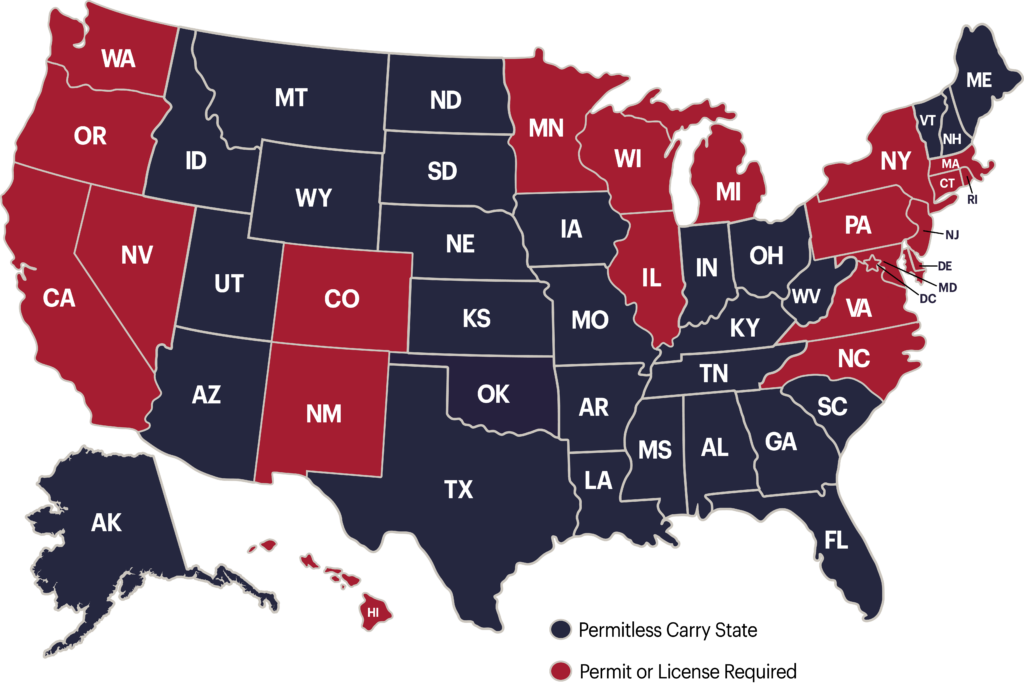
Carry Allowed Without a Permit
- Any person while in his own place of abode or the curtilage thereof.
- Any person while in his own place of business;
- Any law-enforcement officer, wherever such law-enforcement officer may travel in the Commonwealth;
- Any regularly enrolled member of a target shooting organization who is at, or going to or from, an established shooting range, provided that the weapons are unloaded and securely wrapped while being transported;
- Any regularly enrolled member of a weapons collecting organization who is at, or going to or from, a bona fide weapons exhibition, provided that the weapons are unloaded and securely wrapped while being transported;
- Any person carrying such weapons between his place of abode and a place of purchase or repair, provided the weapons are unloaded and securely wrapped while being transported;
- Any person actually engaged in lawful hunting, as authorized by the Board of Game and Inland Fisheries, under inclement weather conditions necessitating temporary protection of his firearm from those conditions. Possession of a handgun while engaged in lawful hunting shall not be construed as hunting with a handgun if the person hunting is carrying a valid concealed handgun permit;
- Any retiree described in paragraph C 2 of Virginia Code Section 18.2-308.16.
- For purposes of applying the reciprocity provisions of subsection P, any person granted the privilege to carry a concealed handgun pursuant to this subdivision, while carrying the proof of consultation and favorable review required, shall be deemed to have been issued a concealed handgun permit.
- Any attorney for the Commonwealth or assistant attorney for the Commonwealth, wherever such attorney may travel in the Commonwealth.
- Any person who may lawfully possess a firearm and is carrying a handgun while in a personal, private motor vehicle or vessel and such handgun is secured in a container or compartment in the vehicle or vessel.
VA Code § 18.2-308
Reciprocity Agreements
Reciprocity refers to an agreement between states to recognize, or honor, a concealed firearm permit issued by another state.
When you are in another state, you are subject to that state’s laws. Even if a state recognizes your carry permit or allows for permitless carry, the state may have additional restrictions on certain types of firearms, magazines, or ammunition. Take time to learn the law!

State Preemption Laws
State firearm preemption laws are statutes that prevent local governments from enacting or enforcing their own gun regulations that are more restrictive than state law. These laws ensure that firearm regulations remain consistent across the state, preventing a patchwork of different rules in various cities or counties.
Virginia has a preemption law, albeit, one that was watered down to allow additional local restrictions with the addition of subsection (E) in 2020.
VA Code § 15.2-915
Purchase/Transfer Laws
When buying or selling a firearm, both federal and state laws must be followed. Under 18 U.S.C. § 922(a)(5), a private party may sell a firearm to a resident of the same state if two conditions are met: (1) the seller and buyer must be residents of the same state, and (2) the seller must not know or have reasonable cause to believe that the buyer is prohibited from receiving or possessing firearms under federal law, as outlined in 18 U.S.C. § 922(g).
Additionally, a private seller may loan or rent a firearm to a resident of any state for temporary lawful sporting use, provided they meet the same condition of not knowing or having reason to believe the borrower is prohibited under federal law.
In addition to federal law, state laws governing firearm sales must also be followed, as states may impose additional restrictions such as background checks, waiting periods, or bans on specific types of firearms.
Effective July 1, 2020, Virginia generally prohibits any person from selling a firearm “for money, goods, services or anything else of value” unless the seller has received verification from a licensed dealer that the buyer has undergone a background check and been approved by the State Police.
Virginia law also prohibits anyone from buying a gun without undergoing this background check. The process must conform with the process used by a dealer to perform a background check on the buyer of a firearm from the dealer’s own inventory.
Firearm Safety Device Tax Credit Expansion (HB 2595/SB 1389, 2025): Expands eligibility for gun safety device tax credits to include purchases from any retailer, not just FFL dealers. Effective July 1, 2025.
Virginia Law:
- Any person who willfully and intentionally sells a firearm to another person without obtaining verification in accordance with this section is guilty of a Class 1 misdemeanor.
- Any person who willfully and intentionally purchases a firearm from another person without obtaining verification in accordance with this section is guilty of a Class 1 misdemeanor.
VA Code § 18.2-308.2:5
Possession, transportation, or purchase of certain firearms by certain persons; Penalty. Provides additional exceptions, outlined in the bill, for persons younger than 18 years of age to possess or transport handguns or assault firearms anywhere in the Commonwealth. The bill also makes it a Class 1 misdemeanor for persons younger than 21 years of age to purchase a handgun or assault firearm anywhere in the Commonwealth. Governor signed bill into law on April 23, 2026.Be it enacted by the General Assembly of Virginia:
1. That § 18.2-308.7 of the Code of Virginia is amended and reenacted as follows:§ 18.2-308.7. Purchase, possession, or transportation of certain firearms by persons younger than 21 years of age; Penalty.It is unlawful for any person younger than 21 years of age to knowingly and intentionally purchase, possess, or transport a handgun or assault firearm anywhere in the Commonwealth. For the purposes of this section, "handgun" means any pistol or revolver or other firearm originally designed, made, and intended to fire single or multiple projectiles by means of an explosion of a combustible material from one or more barrels when held in one hand and "assault firearm" means any (i) semi-automatic centerfire rifle or pistol which expels single or multiple projectiles by action of an explosion of a combustible material and is equipped at the time of the offense with a magazine which will hold more than 20 rounds of ammunition or designed by the manufacturer to accommodate a silencer or equipped with a folding stock or (ii) shotgun with a magazine which will hold more than seven rounds of the longest ammunition for which it is chambered. A violation of this section shall be a Class 1 misdemeanor.
This section shall not apply to:
1. Any person while a resident of the home or property of his parent, grandparent, or legal guardian, provided that such weapon was used during the course of a lawful act of self-defense or defense of another person;
Any person who, while accompanied by an adult, is at a lawful shooting range or firearms educational class;
2. Any person who, while accompanied by an adult, is actually engaged in lawful hunting; and
3. Any person while carrying out his duties in the Armed Forces of the United States or the National Guard of this Commonwealth or any other state.
VA Code § 18.2-308.7
Effective July 1, 2026
Purchase, sale, transfer, etc., of assault firearms and certain ammunition feeding devices prohibited; Penalties. (HB217)(2026)
Creates a Class 1 misdemeanor for any person who imports, sells, manufactures, purchases, or transfers an assault firearm, as that term is defined in the bill with some exceptions, and prohibits a person who has been convicted of such violation from purchasing, possessing, or transporting a firearm for a period of three years from the date of conviction. The bill provides that an assault firearm does not include any firearm that is an antique firearm, has been rendered permanently inoperable, or is manually operated by bolt, pump, lever, or slide action. The bill also prohibits the sale of a large capacity ammunition feeding device, as that term is defined in the bill. The bill provides that any person who willfully and intentionally (i) sells an assault firearm to another person or (ii) purchases an assault firearm from another person is guilty of a Class 1 misdemeanor and that any person who imports, sells, barters, transfers, or purchases a large capacity ammunition feeding device is guilty of a Class 1 misdemeanor.
Be it enacted by the General Assembly of Virginia:
1. That §§ 18.2-308.09, 18.2-308.2:1, 18.2-308.2:2, 18.2-308.2:3, 18.2-308.2:5, and 18.2-308.7 of the Code of Virginia are amended and reenacted and that the Code of Virginia is amended by adding sections numbered 18.2-287.4:1, 18.2-287.4:2, 18.2-308.1:9, and 18.2-309.1 as follows:
§ 18.2-287.4:1. Importation, sale, manufacture, etc., of assault firearms prohibited; Penalty.
A. As used in this section, an "assault firearm" means the same as that term is defined in § 18.2-308.2:2.
B. Any person who imports, sells, manufactures, purchases, or transfers an assault firearm is guilty of a Class 1 misdemeanor.
C. The provisions of this section shall not apply to (i) any government officer, agent, or employee, or member of the Armed Forces of the United States, to the extent that such person is otherwise authorized to acquire or possess an assault firearm and does so while acting within the scope of his duties; (ii) the manufacture of an assault firearm by a firearms manufacturer for the purpose of sale to any branch of the Armed Forces of the United States, senior military colleges in the Commonwealth organized under 10 U.S.C. § 2111a(f), or to a law-enforcement agency in the Commonwealth for use by that agency or its employees, provided that the manufacturer is properly licensed under federal, state, and local laws; (iii) the sale or transfer of an assault firearm by a licensed dealer to any branch of the Armed Forces of the United States or to a law-enforcement agency in the Commonwealth for use by that agency or its employees; or (iv) any member of a cadet corps who is recognized by a public institution of higher education while such member is in the performance of lawful military training or such member is participating in an official ceremonial event for the Commonwealth.
§ 18.2-287.4:2. Importation, sale, possession, etc., of assault firearms prohibited by persons younger than 21 years of age; Penalty.
A. As used in this section, an "assault firearm" means the same as that term is defined in § 18.2-308.2:2 except that it includes such firearms manufactured before July 1, 2026.
B. Any person younger than 21 years of age who imports, sells, manufactures, purchases, possesses, transports, or transfers an assault firearm is guilty of a Class 1 misdemeanor.
C. The provisions of this section shall not apply to (i) any government officer, agent, or employee, or member of the Armed Forces of the United States, to the extent that such person is otherwise authorized to acquire or possess an assault firearm and does so while acting within the scope of his duties; (ii) the manufacture of an assault firearm by a firearms manufacturer for the purpose of sale to any branch of the Armed Forces of the United States, senior military colleges in the Commonwealth organized under 10 U.S.C. § 2111a(f), or to a law-enforcement agency in the Commonwealth for use by that agency or its employees, provided that the manufacturer is properly licensed under federal, state, and local laws; (iii) the sale or transfer of an assault firearm by a licensed dealer to any branch of the Armed Forces of the United States or to a law-enforcement agency in the Commonwealth for use by that agency or its employees; or (iv) any member of a cadet corps who is recognized by a public institution of higher education while such member is in the performance of lawful military training or such member is participating in an official ceremonial event for the Commonwealth.
§ 18.2-308.09. Disqualifications for a Concealed Handgun Permit.
The following persons shall be deemed disqualified from obtaining a permit:
1. An individual who is ineligible to possess a firearm pursuant to § 18.2-308.1:1, 18.2-308.1:2, 18.2-308.1:3, 18.2-308.1:6, 18.2-308.1:7, 18.2-308.1:8, or 18.2-308.1:9 or the substantially similar law of any other state or of the United States.
§ 18.2-308.1:9. Purchase, possession, or transportation of firearm following conviction for importation, sale, possession, etc., of assault firearm; Penalty.
A. Any person who knowingly and intentionally purchases, possesses, or transports any firearm following a misdemeanor conviction for a violation of § 18.2-287.4:1 or 18.2-287.4:2 is guilty of a Class 1 misdemeanor.
B. Any person convicted of a violation of § 18.2-287.4:1 or 18.2-287.4:2 or this section shall be prohibited from purchasing, possessing, or transporting a firearm for three years following the date of such conviction at which point the person convicted of such offense shall no longer be prohibited from purchasing, possessing, or transporting a firearm pursuant to this section. Such person shall have his firearms rights restored, unless such person receives another disqualifying conviction, is subject to a protective order that would restrict his rights to carry a firearm, or is otherwise prohibited by law from purchasing, possessing, or transporting a firearm.
§ 18.2-308.2:1. Prohibiting the selling, etc., of firearms to certain persons; Penalties.
Any person who sells, barters, gives, or furnishes, or has in his possession or under his control with the intent of selling, bartering, giving, or furnishing, any firearm to any person he knows is prohibited from purchasing, possessing, or transporting a firearm pursuant to § 18.2-308.1:7, 18.2-308.1:8, or 18.2-308.1:9 is guilty of a Class 1 misdemeanor.
§ 18.2-308.2:2. Criminal history record information check required for the transfer of certain firearms; Penalties.
A. Any person purchasing from a dealer a firearm as defined in this section shall consent in writing, on a form to be provided by the Department of State Police, to have the dealer obtain criminal history record information and if such firearm is an assault firearm manufactured before July 1, 2026, such person purchasing such assault firearm shall be 21 years of age or older.
B. 1. No dealer shall sell, rent, trade, or transfer from his inventory any such firearm to any other person who is a resident of Virginia until he has (i) obtained written consent and the other information on the consent form specified in subsection A, and provided the Department of State Police with the name, birth date, gender, race, citizenship, and social security and/or any other identification number and the number of firearms by category intended to be sold, rented, traded, or transferred; (ii) requested criminal history record information by a telephone call to or other communication authorized by the State Police and is authorized by subdivision 2 to complete the sale or other such transfer; and (iii) if such firearm is an assault firearm manufactured before July 1, 2026, verified that such person is 21 years of age or older.
In addition, no dealer shall sell, rent, trade, or transfer from his inventory any assault firearm to any person or any semi-automatic center-fire rifle or pistol that expels single or multiple projectiles by action of an explosion of a combustible material and is equipped at the time of the offense with a magazine that will hold more than 20 rounds of ammunition or is designed by the manufacturer to accommodate a silencer or is equipped with a folding stock to any person who is not a citizen of the United States or who is not a person lawfully admitted for permanent residence.
E. Any dealer who willfully and intentionally requests, obtains, or seeks to obtain criminal history record information under false pretenses, or who willfully and intentionally disseminates or seeks to disseminate criminal history record information except as authorized in this section, is guilty of a Class 2 misdemeanor.
4. Any curio or relic as defined in this subsection.
"Assault firearm" means:
1. A semi-automatic center-fire rifle or pistol that expels single or multiple projectiles by action of an explosion of a combustible material with a fixed magazine capacity in excess of 10 rounds;
2. A semi-automatic center-fire rifle that expels single or multiple projectiles by action of an explosion of a combustible material that has the ability to accept a detachable magazine and has one of the following characteristics: (i) a folding, telescoping, or collapsible stock; (ii) a pistol grip that protrudes conspicuously beneath the action of the rifle; (iii) a second handgrip or a protruding grip that can be held by the non-trigger hand; (iv) a grenade launcher; (v) a flare launcher; (vi) a sound suppressor; (vii) a flash suppressor; (viii) a muzzle brake; (ix) a muzzle compensator; (x) a threaded barrel capable of accepting (a) a sound suppressor, (b) a flash suppressor, (c) a muzzle brake, or (d) a muzzle compensator; or (xi) any characteristic of like kind as enumerated in clauses (i) through (x);
3. A semi-automatic center-fire pistol that expels single or multiple projectiles by action of an explosion of a combustible material that has the ability to accept a detachable magazine and has one of the following characteristics: (i) a folding, telescoping, or collapsible stock; (ii) a second handgrip or a protruding grip that can be held by the non-trigger hand; (iii) the capacity to accept a magazine that attaches to the pistol outside of the pistol grip; (iv) a shroud that is attached to, or partially or completely encircles, the barrel and that permits the shooter to hold the pistol with the non-trigger hand without being burned; (v) a threaded barrel capable of accepting (a) a sound suppressor, (b) a flash suppressor, (c) a barrel extender, or (d) a forward handgrip; or (vi) any characteristic of like kind as enumerated in clauses (i) through (v);
4. A semi-automatic shotgun that expels single or multiple projectiles by action of an explosion of a combustible material that has one of the following characteristics: (i) a folding, telescoping, or collapsible stock; (ii) a pistol grip that protrudes conspicuously beneath the action of the shotgun; (iii) the ability to accept a detachable magazine; (iv) a fixed magazine capacity in excess of seven rounds; or (v) any characteristic of like kind as enumerated in clauses (i) through (iv); or
5. A shotgun with a magazine that will hold more than seven rounds of the shortest ammunition for which it is chambered.
An "assault firearm" does not include any firearm that is an antique firearm, has been rendered permanently inoperable, is manually operated by bolt, pump, lever, or slide action, or was manufactured before July 1, 2026.
K. Any person willfully and intentionally making a materially false statement on the consent form required in subsection B or C or on such firearm transaction records as may be required by federal law is guilty of a Class 5 felony.
L. Except as provided in § 18.2-308.2:1, any dealer who willfully and intentionally sells, rents, trades, or transfers a firearm in violation of this section is guilty of a Class 6 felony.
L1. Any person who attempts to solicit, persuade, encourage, or entice any dealer to transfer or otherwise convey a firearm other than to the actual buyer, as well as any other person who willfully and intentionally aids or abets such person, is guilty of a Class 6 felony. This subsection shall not apply to a federal law-enforcement officer or a law-enforcement officer as defined in § 9.1-101, in the performance of his official duties, or other person under his direct supervision.
M. Any person who purchases a firearm with the intent to (i) resell or otherwise provide such firearm to any person who he knows or has reason to believe is ineligible to purchase or otherwise receive from a dealer a firearm for whatever reason or (ii) transport such firearm out of the Commonwealth to be resold or otherwise provided to another person who the transferor knows is ineligible to purchase or otherwise receive a firearm, is guilty of a Class 4 felony and sentenced to a mandatory minimum term of imprisonment of one year. However, if the violation of this subsection involves such a transfer of more than one firearm, the person shall be sentenced to a mandatory minimum term of imprisonment of five years. The prohibitions of this subsection shall not apply to the purchase of a firearm by a person for the lawful use, possession, or transport thereof, pursuant to § 18.2-308.7, by his child, grandchild, or individual for whom he is the legal guardian if such child, grandchild, or individual is ineligible, solely because of his age, to purchase a firearm.
N. Any person who is ineligible to purchase or otherwise receive or possess a firearm in the Commonwealth who solicits, employs, or assists any person in violating subsection M is guilty of a Class 4 felony and shall be sentenced to a mandatory minimum term of imprisonment of five years.
R. Except as provided in subdivisions 1 and 2, it is unlawful for any person who is not a licensed firearms dealer to purchase more than one handgun within any 30-day period. For the purposes of this subsection, "purchase" does not include the exchange or replacement of a handgun by a seller for a handgun purchased from such seller by the same person seeking the exchange or replacement within the 30-day period immediately preceding the date of exchange or replacement. A violation of this subsection is punishable as a Class 1 misdemeanor.
S. No person shall purchase an assault firearm manufactured before July 1, 2026, from a dealer unless such person is 21 years of age or older.
T. No dealer shall sell, rent, trade, or transfer from his inventory an assault firearm manufactured before July 1, 2026, to any person unless such person is 21 years of age or older.
§ 18.2-308.2:3. Criminal background check required for employees of a gun dealer to transfer firearms; Exemptions; Penalties.
I. Any person who willfully and intentionally requests, obtains, or seeks to obtain criminal history record information under false pretenses, or who willfully and intentionally disseminates or seeks to disseminate criminal history record information except as authorized by this section and § 18.2-308.2:2, is guilty of a Class 2 misdemeanor.
J. Any person willfully and intentionally making a materially false statement on the personal descriptive information required in this section is guilty of a Class 5 felony. Any person who offers for transfer any firearm in violation of this section is guilty of a Class 1 misdemeanor. Any dealer who willfully and knowingly employs or permits a person to act as a firearm seller in violation of this section is guilty of a Class 1 misdemeanor.
K. There is no civil liability for any seller for the actions of any purchaser or subsequent transferee of a firearm lawfully transferred pursuant to this section.
L. The provisions of this section requiring a seller's background check shall not apply to a licensed dealer.
M. Any person who willfully and intentionally makes a false statement in the affidavit as set out in subdivision C 1 is guilty of a Class 5 felony.
§ 18.2-308.2:5. Criminal history record information check required to sell firearm; Penalties.
E. No person shall sell an assault firearm as defined in § 18.2-308.2:2 for money, goods, services, or anything else of value.
Any person who willfully and intentionally (i) sells an assault firearm as defined in § 18.2-308.2:2 to another person or (ii) purchases an assault firearm as defined in § 18.2-308.2:2 from another person is guilty of a Class 1 misdemeanor.
§ 18.2-308.7. Possession or transportation of certain firearms by persons under the age of 18; Penalty.
It is unlawful for any person under 18 years of age to knowingly and intentionally possess or transport a handgun anywhere in the Commonwealth. For the purposes of this section, "handgun" means any pistol or revolver or other firearm originally designed, made, and intended to fire single or multiple projectiles by means of an explosion of a combustible material from one or more barrels when held in one hand. A violation of this section is a Class 1 misdemeanor.
This section shall not apply to:
1. Any person (i) while in his home or on his property; (ii) while in the home or on the property of his parent, grandparent, or legal guardian; or (iii) while on the property of another who has provided prior permission, and with the prior permission of his parent or legal guardian if the person has the landowner's written permission on his person while on such property; 2. Any person who, while accompanied by an adult, is at, or going to and from, a lawful shooting range or firearms educational class, provided that the weapons are unloaded while being transported;
3. Any person actually engaged in lawful hunting or going to and from a hunting area or preserve, provided that the weapons are unloaded while being transported; and 4. Any person while carrying out his duties in the Armed Forces of the United States or the National Guard of this Commonwealth or any other state.
§ 18.2-309.1. Sale, transfer, etc., of certain firearms magazines prohibited; Penalty.
A. As used in this section, a "large capacity ammunition feeding device" means a magazine, belt, drum, feed strip, or similar device manufactured on or after July 1, 2026, that has a capacity of, or that can be readily restored or converted to accept, more than 10 rounds of ammunition but does not include an attached tubular device designed to accept and capable of operating only with .22 caliber rimfire ammunition.
B. Any person who imports, sells, barters, or transfers a large capacity ammunition feeding device is guilty of a Class 1 misdemeanor.
C. The provisions of this section shall not apply to the manufacture of a large capacity ammunition feeding device by, transfer of a large capacity ammunition feeding device to, or possession of a large capacity ammunition feeding device by the Commonwealth or a department, agency, or political subdivision of the Commonwealth, transfer of a large capacity ammunition feeding device to or possession of a large capacity ammunition feeding device by a law-enforcement officer employed by such an entity for purposes of law enforcement, or possession of a large capacity ammunition feeding device by an individual who is retired from service with a law-enforcement agency and is not otherwise prohibited from receiving ammunition transferred to the individual by the law-enforcement agency upon his retirement.
VA Code §§ 18.2-287.4:1, 18.2-287.4:2, 18.2-308.09, 18.2-308.1:9, 18.2-308.2:1, 18.2-308.2:2, 18.2-308.2:3, 18.2-308.2:5, 18.2-308.7, and 18.2-309.1
Effective July 1, 2026
Manufacture, importation, sale, transfer, or possession of plastic firearms and unfinished frames or receivers and unserialized firearms prohibited; Penalties. (SB323/HB40)(2026) Creates a Class 5 felony for any person who knowingly manufactures or assembles, imports, purchases, sells, transfers, or possesses any firearm that, after removal of all parts other than a major component, as defined in the bill, is not detectable as a firearm when subjected to inspection by the types of detection devices, including X-ray machines, commonly used at airports, government buildings, schools, correctional facilities, and other locations for security screening. The bill updates language regarding the types of detection devices that are used at such locations for detecting plastic firearms. Under current law, it is unlawful to manufacture, import, sell, transfer, or possess any plastic firearm and a violation is punishable as a Class 5 felony.
The bill also creates a Class 1 misdemeanor, which is punishable as a Class 4 felony for a second or subsequent offense, for any person to knowingly possess a firearm or any completed or unfinished frame or receiver that is not imprinted with a valid serial number or to knowingly import, purchase, sell, offer for sale, or transfer ownership of any completed or unfinished frame or receiver, unless the completed or unfinished frame or receiver (i) is deemed to be a firearm pursuant to federal law and (ii) is imprinted with a valid serial number. The bill also creates a Class 1 misdemeanor, which is punishable as a Class 4 felony for a second or subsequent offense, for any person to manufacture or assemble, cause to be manufactured or assembled, import, purchase, sell, offer for sale, or transfer ownership of any firearm that is not imprinted with a valid serial number. The provisions of the bill prohibiting unfinished frames or receivers and unserialized firearms have a delayed effective date of January 1, 2027; however, the provisions of the bill prohibiting the knowing possession of a firearm or any completed or unfinished frame or receiver that is not imprinted with a valid serial number have a delayed effective date of July 1, 2027. This bill is identical to HB 40.
Be it enacted by the General Assembly of Virginia:
1. That § 18.2-308.5 of the Code of Virginia is amended and reenacted and that the Code of Virginia is amended by adding a section numbered 18.2-308.5:2 as follows:
§ 18.2-308.5. Manufacture, assembly, importation, etc., of plastic or other nondetectable firearm prohibited; Penalty.
A. It shall be is unlawful for any person to knowingly manufacture or assemble, cause to be manufactured or assembled, import, purchase, sell, offer for sale, transfer, or possess (i) any plastic firearm or (ii) any firearm that, after removal of all parts other than a major component, is not detectable as a firearm by the types of detection devices, including X-ray machines, commonly used at airports, government buildings, schools, correctional facilities, and other locations for security screening.
B. As used in this section, "plastic:
"Frame" and "receiver" have the same meanings attributed to them in 18 U.S.C. § 921 et seq. and regulations issued pursuant thereto.
"Major component" means (i) the slide or cylinder, or the frame or receiver, of the firearm or (ii) in the case of a rifle or shotgun, the barrel of the firearm.
"Plastic firearm" means any firearm, including machine guns and sawed-off shotguns as defined in this chapter, containing less than 3.7 ounces of electromagnetically detectable metal in the barrel, slide, cylinder, frame, or receiver of which that, when subjected to inspection by the types of detection devices, including X-ray machines, commonly used at airports, government buildings, schools, correctional facilities, and other locations for security screening, does not generate an image that accurately depicts its shape.
C. A violation of this section shall be is punishable as a Class 5 felony.
§ 18.2-308.5:2. Prohibition on unfinished frames or receivers and unserialized firearms; Penalties.
A. As used in this section:
"Federal licensee authorized to serialize firearms" means a person, firm, corporation, or other entity that holds any valid federal license that authorizes the person, firm, corporation, or other entity to imprint serial numbers onto firearms and completed or unfinished frames or receivers pursuant to 18 U.S.C. § 921 et seq. and regulations issued pursuant thereto.
"Federally licensed gunsmith, manufacturer, or importer" means a person, firm, corporation, or other entity that holds a valid gunsmith license or license to manufacture or import firearms issued pursuant to 18 U.S.C. § 921 et seq. and regulations issued pursuant thereto.
"Frame" and "receiver" have the same meanings attributed to them in 18 U.S.C. § 921 et seq. and regulations issued pursuant thereto.
"License to manufacture firearms" means a valid license to manufacture firearms issued pursuant to 18 U.S.C. § 921 et seq. and regulations issued pursuant thereto.
"Manufacture or assemble" means to fabricate, construct, fit together component parts of, or otherwise produce a firearm or completed or unfinished frame or receiver, including through additive, subtractive, or other processes.
"Unfinished frame or receiver" means a forging, casting, printing, extrusion, machined body, or similar item that (i) is designed to or may readily be completed, assembled, or otherwise converted to function as a frame or receiver or (ii) is marketed or sold to the public to become or be used as the frame or receiver of a functional firearm once completed, assembled, or otherwise converted. However, "unfinished frame or receiver" does not include a component designed and intended for use in an antique weapon.
"Valid serial number" means a serial number that has been imprinted by a federal licensee authorized to serialize firearms in accordance with federal law, or that has otherwise been assigned to a firearm or completed or unfinished frame or receiver pursuant to the laws of any state or pursuant to 26 U.S.C. § 5801 et seq. and regulations issued pursuant thereto.
B. It is unlawful to knowingly import, purchase, sell, offer for sale, or transfer ownership of any completed or unfinished frame or receiver, unless the completed or unfinished frame or receiver (i) is deemed to be a firearm pursuant to 18 U.S.C. § 921 et seq. and regulations issued pursuant thereto and (ii) is imprinted with a valid serial number.
C. It is unlawful to knowingly possess a firearm or any completed or unfinished frame or receiver that is not imprinted with a valid serial number.
D. It is unlawful to manufacture or assemble, cause to be manufactured or assembled, import, purchase, sell, offer for sale, or transfer ownership of any firearm that is not imprinted with a valid serial number.
E. Except as authorized by law, it is unlawful for a person who does not have a valid federal license to manufacture or assemble firearms to sell or transfer ownership of a firearm if (i) the person manufactured or assembled the firearm without a valid license to manufacture firearms, (ii) the person knowingly caused the firearm to be manufactured or assembled by another person who does not have a valid federal license to manufacture firearms, or (iii) the person is aware that the firearm was manufactured or assembled by another person who does not have a valid federal license to manufacture firearms.
F. A federal firearms licensee may serialize a firearm or frame or receiver of a firearm, including a finished or unfinished frame or receiver, by imprinting a serial number on the firearm, frame, or receiver. To serialize a firearm, frame, or receiver, the dealer or other licensee shall imprint on the firearm, frame, or receiver a serial number beginning with the dealer's or licensee's abbreviated federal firearms license number, which is the first three and last five digits of the license number, followed by a hyphen, before a unique identification number (12345678-(number)). The serial number shall not be duplicated on any other firearm, frame, or receiver serialized by the licensee and shall be imprinted in a manner that complies with the requirements in federal law for imprinting a serial number on a firearm, including the minimum size and depth of the serial number and that the serial number is not susceptible to being readily obliterated, altered, or removed.
The federal firearms licensee shall retain a record concerning a firearm, frame, or receiver serialized by the licensee that complies with the requirements under federal law for the sale of a firearm. In addition to any record required by federal law, a federal firearms licensee that imprints a unique serial number on a firearm, frame, or receiver pursuant to this subsection shall make a record at the time of the transaction of each transaction involving serializing a firearm, frame, or receiver and keep that record. The record shall include the following information: the date, name, age, and residence of any person to whom the item is transferred and the unique serial number imprinted on the firearm, frame, or receiver.
G. A violation of this section is punishable as a Class 1 misdemeanor. A second or subsequent violation of this section is punishable as a Class 4 felony.
H. The provisions of subsection B or C shall not apply to any person possessing or receiving the firearm who is a local, state, or federal law-enforcement officer or a federal firearms importer or federal firearms manufacturer in the scope and course of his official duties or employment.
I. This section does not apply to any of the following:
1. A firearm, frame, receiver, or unfinished frame or receiver that (i) is an antique firearm as defined in subsection F of § 18.2-308.2:2, (ii) has been rendered permanently inoperable, or (iii) was manufactured before October 22, 1968;
2. The sale, offer for sale, or transfer of ownership of a firearm or any completed or unfinished frame or receiver to a law-enforcement agency;
3. The manufacture or assembly, importation, purchase, transfer, or possession of a firearm or any completed or unfinished frame or receiver by a law-enforcement agency for law-enforcement purposes;
4. The sale or transfer of ownership of a firearm or any completed or unfinished frame or receiver to a federally licensed gunsmith, manufacturer, or importer or to any other federal licensee authorized to serialize firearms;
5. The manufacture or assembly, importation, purchase, or possession of a firearm or any completed or unfinished frame or receiver by a federally licensed gunsmith, manufacturer, or importer or by any other federal licensee authorized to serialize firearms;
6. A member of the Armed Forces of the United States or the National Guard while on duty and acting within the scope and course of employment or any law-enforcement agency or forensic laboratory;
7. A common carrier, motor carrier, air carrier, or carrier affiliated with an air carrier through common controlling interest that is subject to Title 49 of the United States Code, or an authorized agent of any such carrier, when acting in the course and scope of duties incident to the receipt, processing, transportation, or delivery of property;
8. An authorized representative of a local, state, or federal government that receives a firearm or any completed or unfinished frame or receiver as part of an authorized, voluntary buyback program in which the governmental entity is buying or receiving such weapons from private individuals;
9. The possession and disposition of a firearm or any completed or unfinished frame or receiver by a person who meets all of the following:
a. The person is not prohibited by Virginia or federal law from possessing the weapon;
b. The person possessed the firearm or any completed or unfinished frame or receiver no longer than was necessary to deliver it to a law-enforcement agency for that agency's disposition according to law; and
c. If the person is transporting the firearm or any completed or unfinished frame or receiver, the person is transporting it to a law-enforcement agency in order to deliver it to the agency for the agency's disposition according to law;
10. The possession or importation of a firearm or any completed or unfinished frame or receiver by a nonresident of the Commonwealth who:
a. Is traveling with the firearm or completed or unfinished frame or receiver in the Commonwealth in accordance with the provisions of 18 U.S.C. § 926A; or
b. Possesses or imports the firearm or completed or unfinished frame or receiver in the Commonwealth exclusively for use in an organized sport shooting event or competition and no longer than reasonably necessary to participate in such an event or competition; or
11. The possession or importation of a firearm or any completed or unfinished frame or receiver by a new resident moving into the Commonwealth who, within 90 days of moving into the Commonwealth, causes the firearm or completed or unfinished frame or receiver to be imprinted with a valid serial number, removes the weapon from the Commonwealth, or otherwise comes into compliance with this section.
2. That the provisions of this act may result in a net increase in periods of imprisonment or commitment. Pursuant to § 30-19.1:4 of the Code of Virginia, the estimated amount of the necessary appropriation cannot be determined for periods of imprisonment in state adult correctional facilities; therefore, Chapter 725 of the Acts of Assembly of 2025, requires the Virginia Criminal Sentencing Commission to assign a minimum fiscal impact of $50,000. Pursuant to § 30-19.1:4 of the Code of Virginia, the estimated amount of the necessary appropriation cannot be determined for periods of commitment to the custody of the Department of Juvenile Justice.
3. That the provisions of § 18.2-308.5:2 of the Code of Virginia, as created by this act, with the exception of subsection C, shall become effective on January 1, 2027.
4. That the provisions of subsection C of § 18.2-308.5:2 of the Code of Virginia, as created by this act, shall become effective on July 1, 2027.
VA Code §§ 18.2-308.5 and 18.2-308.5:2
Effective July 1, 2027
The bill requires these businesses to establish and implement vague and subjective “reasonable controls” over the manufacture, sale, distribution, use, and marketing of firearm-related products. Further, it establishes a broad civil cause of action, allowing the Attorney General, local government attorneys, or private individuals to sue firearm businesses for injunctions, damages, and costs. This is a direct attack on the firearm industry and are designed to regulate the industry out of existence through litigation—despite longstanding federal protections.
Be it enacted by the General Assembly of Virginia:
1. That the Code of Virginia is amended by adding in Title 59.1 a chapter numbered 11.2, consisting of sections numbered 59.1-148.5, 59.1-148.6, and 59.1-148.7, as follows:
CHAPTER 11.2.
VIRGINIA FIREARM INDUSTRY STANDARDS OF RESPONSIBLE CONDUCT.
§ 59.1-148.5. Definitions.
As used in this chapter, unless the context requires a different meaning:
"Firearm" means any handgun, shotgun, or rifle that will or is designed to or may readily be converted to expel single or multiple projectiles by action of an explosion of a combustible material.
"Firearm accessory" means an attachment or device designed or adapted to be inserted into, affixed onto, or used in conjunction with a firearm that is designed, is intended, or functions to alter or enhance the firing capabilities of a firearm, the lethality of the firearm, or a shooter's ability to hold and use a firearm.
"Firearm industry member" means a person engaged in the sale, manufacturing, distribution, importing, or marketing of a firearm-related product.
"Firearm-related product" means a firearm, ammunition, a firearm component, including unfinished frames or receivers, or a firearm accessory that was (i) sold, made, distributed, or marketed in the Commonwealth; (ii) intended to be sold, made, distributed, or marketed in the Commonwealth; or (iii) possessed in the Commonwealth, and it was reasonably foreseeable that the product would be possessed or used in the Commonwealth.
"Firearm trafficker" means a person who acquires, transfers, or attempts to acquire or transfer a firearm for purposes of unlawful commerce.
"Frame" and "receiver" have the same meanings attributed to them in 18 U.S.C. § 921 et seq. and regulations issued pursuant thereto.
"Public nuisance" means a condition that injures, endangers, or threatens to injure or endanger or contributes to the injury or endangerment of the health, safety, peace, comfort, or convenience of others or otherwise constitutes a public nuisance under common law.
"Reasonable controls" means reasonable procedures, safeguards, and business practices that are designed to (i) prevent the sale or distribution of a firearm-related product to a straw purchaser, a firearm trafficker, a person prohibited from possessing a firearm under state or federal law, or a person who the firearm industry member has reasonable cause to believe is at substantial risk of using a firearm-related product to harm themselves or unlawfully harm another or of unlawfully possessing or using a firearm-related product; (ii) prevent the loss of a firearm-related product or theft of a firearm-related product from a firearm industry member; (iii) ensure that the firearm industry member complies with all provisions of state and federal law and does not otherwise promote the unlawful manufacture, sale, possession, marketing, or use of a firearm-related product; or (iv) ensure that the firearm industry member does not engage in an act or practice in violation of the Virginia Consumer Protection Act (§ 59.1-196 et seq.).
"Straw purchaser" means an individual who conceals, or intends to conceal, from a person that the purchase of a firearm-related product is being made on behalf of a third party. A "straw purchaser" does not include a bona fide gift to a person who is not prohibited by law from possessing or receiving a firearm-related product. For purposes of this chapter, a gift to a person is not a bona fide gift if the person has offered or given the purchaser a service or thing of value to acquire the firearm-related product for the person.
"Unfinished frame or receiver" means a forging, casting, printing, extrusion, machined body, or similar item that (i) is designed to or may readily be completed, assembled, or otherwise converted to function as a frame or receiver or (ii) is marketed or sold to the public to become or be used as the frame or receiver of a functional firearm once completed, assembled, or otherwise converted. However, "unfinished frame or receiver" does not include a component designed and intended for use in an antique weapon.
§ 59.1-148.6. Firearm industry standards of responsible conduct; civil liability.
A. A firearm industry member, by conduct unlawful in itself or unreasonable under all the circumstances, may not knowingly or recklessly create, maintain, or contribute to a public nuisance through the sale, manufacturing, importing, or marketing of a firearm-related product.
B. A firearm industry member shall establish and implement reasonable controls regarding the manufacture, sale, distribution, use, and marketing of the firearm industry member's firearm-related products.
C. A violation of subsection A or B is a public nuisance.
D. A firearm industry member's conduct constitutes a proximate cause of the public nuisance if the harm to the public is a reasonably foreseeable effect of the conduct, notwithstanding any intervening actions, including criminal actions by third parties.
E. Whenever it appears to the Attorney General or the local county or city attorney that a firearm industry member has engaged in or is engaging in conduct in violation of this section, the Attorney General or local county or city attorney may commence an action to seek and obtain (i) an injunction prohibiting the firearm industry member from continuing the conduct or engaging in the conduct or doing any acts in furtherance of the conduct; (ii) an order providing for abatement of the public nuisance at the expense of the firearm industry member; (iii) an order of restitution; (iv) an award of compensatory and punitive damages; (v) an award of reasonable attorney fees and costs of the action; and (vi) any other appropriate relief that may be awarded by the court.
F. Any person that has been injured as a result of a firearm industry member's acts or omissions in violation of this section may commence an action to seek and obtain (i) an injunction prohibiting the firearm industry member from continuing the conduct or engaging in the conduct or doing any acts in furtherance of the conduct, (ii) an award of compensatory and punitive damages, and (iii) an award of reasonable attorney fees and costs of the action.
G. To prevail in an action under this section, the party seeking relief is not required to demonstrate that the firearm industry member acted with the intent to engage in a public nuisance or otherwise cause harm to the public.
H. This section shall not be construed or implied to limit or impair in any way (i) the right of a person to pursue a legal action under any other law or (ii) an obligation or requirement placed on a firearm industry member by any other law.
Nothing in this section is intended to restrict or alter the availability of an action for relief from or to remedy a public nuisance at common law.
§ 59.1-148.7. Limitation of action; venue.
A. An action brought pursuant to § 59.1-148.6 shall be commenced within two years after the cause of action accrues.
B. An action brought pursuant to § 59.1-148.6 may be brought in the county or city of the Commonwealth (i) in which all or a substantial part of the acts or omissions that form the basis for the cause of action occurred, (ii) where any defendant resided when the cause of action arose or where the principal office of any defendant is located, or (iii) where the plaintiff resides if the plaintiff is a natural person.
VA Code §§ 59.1-148.5, 59.1-148.6, and § 59.1-148.7
Effective July 1, 2026
Firearm Classification and Accessory Restrictions
Virginia defines "assault firearm" to mean: any semi-automatic center-fire rifle or pistol that expels single or multiple projectiles by action of an explosion of a combustible material and is equipped at the time of the offense with a magazine which will hold more than 20 rounds of ammunition or designed by the manufacturer to accommodate a silencer or equipped with a folding stock. However, Virginia does not generally ban assault firearms.
VA Code § 18.2-308.2:01
Magazine Capacity Restrictions
Magazine capacity laws are designed to limit the number of rounds a firearm's magazine can hold, typically restricting it to a certain number of cartridges (e.g., 10 rounds or fewer). Some state laws restrict the amount of rounds that may be placed in a magazine at any given time, while others prevent the mere possession of unloaded magazines capable of accepting more than a certain number of rounds.
Virginia Law:
It shall be unlawful for any person to carry a loaded (a) semi-automatic center-fire rifle or pistol that expels single or multiple projectiles by action of an explosion of a combustible material and is equipped at the time of the offense with a magazine that will hold more than 20 rounds of ammunition or designed by the manufacturer to accommodate a silencer or equipped with a folding stock or (b) shotgun with a magazine that will hold more than seven rounds of the longest ammunition for which it is chambered on or about his person on any public street, road, alley, sidewalk, public right-of-way, or in any public park or any other place of whatever nature that is open to the public in the Cities of Alexandria, Chesapeake, Fairfax, Falls Church, Newport News, Norfolk, Richmond, or Virginia Beach or in the Counties of Arlington, Fairfax, Henrico, Loudoun, or Prince William.
The provisions of this section shall not apply to law-enforcement officers, licensed security guards, military personnel in the performance of their lawful duties, or any person having a valid concealed handgun permit or to any person actually engaged in lawful hunting or lawful recreational shooting activities at an established shooting range or shooting contest. Any person violating the provisions of this section shall be guilty of a Class 1 misdemeanor.
The exemptions set forth in §§ 18.2-308 and 18.2-308.016 shall apply, mutatis mutandis, to the provisions of this section.
VA Code § 18.2-287.4
Prohibited Areas - Where Firearms Are Prohibited Under State law
Carrying a firearm into a place where firearms are prohibited by state or federal law is a common way for gun owners to find themselves in legal trouble. These places are known as “prohibited areas,” and they can vary greatly from state to state. Below you will find the list of the places where firearms are prohibited under this state’s laws. Keep in mind, in addition to these state prohibited areas, federal law adds additional places where firearms are prohibited. See the federal law section for a list of federal prohibited areas.
Virginia law:
In addition to the federal prohibited areas, in Virginia you may NOT carry a handgun, openly or concealed:
- On Private property when prohibited by the owner of the property, or where posted as prohibited. §18.2-308.01
- To a place of worship while a meeting for religious purposes is being held at such place, without good and sufficient reason. (A Virginia Attorney General Opinion has opined that self-defense constitutes a good and sufficient reason) §18.2-283
- Into any Courthouse. §18.2-283.1
- Within the Capitol of Virginia; Capitol Square and the surrounding area; any building owned or leased by the Commonwealth or any agency thereof; or any office where employees of the Commonwealth or any agency thereof are regularly present for the purpose of performing their official duties. § 18.2-283.2
- In an air carrier airport terminal. §18.2-287.01
- Within 40 foot of Polling Places one hour before opening until one hour after closing. §24.2-604
- On School property, property open to the public and used exclusively for a school function, or a school bus. This prohibition also extends to child day care centers and pre-schools, but is only in place during operating hours for private or religious pre-schools and child day care centers. Some specific exceptions exist, like the ability of a CHP holder to have a weapon inside a vehicle in the parking lot and vehicular ingress and egress portions of a school property. §18.2-308.1
Notwithstanding the provisions of this section, a locality may adopt an ordinance that prohibits the possession, carrying, or transportation of any firearms, ammunition, or components or combination thereof: *Must be posted
- In any building, or part thereof, owned or used by such locality, or by any authority or local governmental entity created or controlled by the locality, for governmental purposes;
- In any public park owned or operated by the locality, or by any authority or local governmental entity created or controlled by the locality;
- In any recreation or community center facility operated by the locality, or by any authority or local governmental entity created or controlled by the locality; or
- In any public street, road, alley, or sidewalk or public right-of-way or any other place of whatever nature that is open to the public and is being used by or is adjacent to a permitted event or an event that would otherwise require a permit.
Note: at least one Virginia court has held this portion unconstitutional with respect to certain city parks and permitted events.
VA Code § 18.2-283, 308
Possession of firearm, stun weapon, or other weapon on school property prohibited;
If any person knowingly possesses any firearm designed or intended to expel a projectile by action of an explosion of a combustible material while such person is upon:
- the property of any child day center or public, private, or religious preschool, elementary, middle, or high school, including buildings and grounds;
- that portion of any property open to the public and then exclusively used for school-sponsored functions or extracurricular activities while such functions or activities are taking place; or
- any school bus owned or operated by any such school; he is guilty of a Class 6 felony.
- Any school board may deem any building or property that it owns or leases where employees of such school board are regularly present for the purpose of performing their official duties, as a gun-free zone (this does not include in a vehicle if permit holder). § 22.1-131.1
Exemptions to this statute include a person who has a valid concealed handgun permit and possesses a concealed handgun while in a motor vehicle in a parking lot, traffic circle, or other means of vehicular ingress or egress to the school.
VA Code § 18.2-308.1
This includes any semiautomatic centerfire rifle or pistol with a fixed magazine capacity over 15 rounds. This law takes effect on July 1, 2026. Be it enacted by the General Assembly of Virginia: 1. That § 18.2-287.4 of the Code of Virginia is amended and reenacted as follows: § 18.2-287.4. Carrying loaded firearms in public areas prohibited; Penalty.It is unlawful for any person to carry a loaded (i) semi-automatic center-fire rifle or pistol that expels single or multiple projectiles by action of an explosion of a combustible material and is (a) equipped at the time of the offense with a magazine that will hold more than 20 rounds of ammunition, (b) designed by the manufacturer to accommodate a silencer, or (c) equipped with a folding stock or (ii) shotgun with a magazine that will hold more than seven rounds of the longest ammunition for which it is chambered on or about his person on any public street, road, alley, sidewalk, public right-of-way, or in any public park or any other place of whatever nature that is open to the public in the Commonwealth.The provisions of this section shall not apply to law-enforcement officers, licensed security guards, military personnel in the performance of their lawful duties, or any person having a valid concealed handgun permit or to any person actually engaged in lawful hunting or lawful recreational shooting activities at an established shooting range or shooting contest. Any person violating the provisions of this section shall be guilty of a Class 1 misdemeanor.The exemptions set forth in §§ 18.2-308 and 18.2-308.016 shall apply, mutatis mutandis, to the provisions of this section.
VA Code § 18.2-287.4
Effective July 1, 2026
*7/22/2026 Update: The provisions of SB727/HB1524, which restrict the public carrying of certain firearms, are not currently in effect. A budget amendment approved by the Virginia General Assembly on June 29, 2026, delayed the law's effective date until July 1, 2027.
Be it enacted by the General Assembly of Virginia:
1. That § 18.2-287.4 of the Code of Virginia is amended and reenacted as follows:
§ 18.2-287.4. Carrying loaded firearms in public areas prohibited; Penalty.
It is unlawful for any person to carry an assault firearm as defined in § 18.2-308.2:2 on or about his person on any public street, road, alley, sidewalk, public right-of-way, or in any public park or any other place of whatever nature that is open to the public.
The provisions of this section shall not apply to law-enforcement officers in the performance of their official duties, military personnel in the performance of their official duties, any member of a cadet corps who is recognized by a public institution of higher education while such member is in the performance of sanctioned military training or such member is participating in an official ceremonial event for the Commonwealth, or any person actually engaged in lawful hunting or lawful recreational shooting activities at an established shooting range or shooting contest. Any person violating the provisions of this section is guilty of a Class 1 misdemeanor.
The exemptions set forth in § 18.2-308 shall apply, mutatis mutandis, to the provisions of this section.
2. That the provisions of this act may result in a net increase in periods of imprisonment or commitment. Pursuant to § 30-19.1:4 of the Code of Virginia, the estimated amount of the necessary appropriation cannot be determined for periods of imprisonment in state adult correctional facilities; therefore, Chapter 725 of the Acts of Assembly of 2025 requires the Virginia Criminal Sentencing Commission to assign a minimum fiscal impact of $50,000. Pursuant to § 30-19.1:4 of the Code of Virginia, the estimated amount of the necessary appropriation cannot be determined for periods of commitment to the custody of the Department of Juvenile Justice.
VA Code § 18.2-287.4
Effective July 1, 2026
*7/22/2026 Update: The provisions of SB727/HB1524, which restrict the public carrying of certain firearms, are not currently in effect. A budget amendment approved by the Virginia General Assembly on June 29, 2026, delayed the law's effective date until July 1, 2027.
The provisions of SB749/HB217, which prohibit the sale, purchase, importation, and transfer of certain firearms classified as "assault firearms" and magazines capable of holding more than 15 rounds, have been temporarily blocked by injunctions issued by two Virginia circuit courts while constitutional challenges proceed.The Hanover County Commonwealth's Attorney's Office will not pursue enforcement of these provisions based on the issuance of these injunctions. Significant constitutional concerns were identified in the letter opinion issued by Judge Scott Campbell of the Washington County Circuit Court. This office shares those concerns, particularly in light of the ongoing litigation challenging the law. This office remains hopeful that these questions will be resolved in a manner that safeguards the rights of law-abiding citizens.
Restrictions on Carrying Certain Firearms in Public (SB727/HB1524)
The provisions of SB727/HB1524, which restrict the public carrying of certain firearms, are not currently in effect. A budget amendment approved by the Virginia General Assembly on June 29, 2026, delayed the law's effective date until July 1, 2027.
The Commonwealth's Attorney's Office will continue to monitor developments in the pending litigation and any additional action taken by the General Assembly or the courts.
*Source: https://www.hanovercounty.gov/1739/Assault-Weapon-Legislation-Status
1. That §§ 15.2-915.5, 18.2-308.09, 18.2-308.2:1, 18.2-308.2:2, 18.2-308.2:3, 18.2-308.2:5, 18.2-308.7, and 19.2-386.28 of the Code of Virginia are amended and reenacted and that the Code of Virginia is amended by adding sections numbered 18.2-287.4:1, 18.2-308.1:9, and 18.2-309.1 as follows:
§ 18.2-287.4:1. Importation, sale, manufacture, etc., of assault firearms prohibited; Penalty.
A. As used in this section:
"Assault firearm" means the same as that term is defined in § 18.2-308.2:2.
"Federal firearms licensee" means any person who is licensed pursuant to 18 U.S.C. § 923, as amended, as a federally licensed firearms dealer, importer, or manufacturer.
B. Any person who imports, sells, manufactures, purchases, or transfers an assault firearm is guilty of a Class 1 misdemeanor.
C. The provisions of this section shall not apply to (i) any government officer, agent, law-enforcement officer, employee, member of the Armed Forces of the United States, security personnel at a contracted defense facility as defined in § 18.2-121.3, or person authorized by the U.S. Nuclear Regulatory Commission, to the extent that such person is otherwise authorized to acquire or possess an assault firearm and does so while acting within the scope of his duties; (ii) the import of an assault firearm by any member of the Armed Forces of the United States, or his spouse, who possessed an assault firearm prior to being in the Commonwealth and is sent to the Commonwealth under lawful orders; (iii) the import, barter, manufacture, transfer, purchase, or sale of an assault firearm by a federal firearms licensee to another federal firearms licensee, persons authorized to purchase an assault weapon, any branch of the Armed Forces of the United States, senior military colleges in the Commonwealth organized under 10 U.S.C. § 2111a(f), or to a law enforcement officer or agency for use by that agency or its employees; (iv) any member of a cadet corps who is recognized by a public institution of higher education while such member is in the performance of lawful military training or such member is participating in an official ceremonial event for the Commonwealth; (v) the sale of an assault firearm by a person who lawfully purchased and possessed such assault firearm prior to July 1, 2026, to a firearms dealer or to an individual outside of the Commonwealth who may lawfully possess such assault firearm; (vi) the temporary transfer of an assault firearm by a person who lawfully purchased and possessed such assault firearm prior to July 1, 2026, to a federal firearms licensee or gunsmith and the return of such assault firearm to its owner; (vii) the receipt of an assault firearm by inheritance, and possession of the inherited assault firearm if the decedent lawfully possessed such assault firearm prior to his death and the person inheriting such assault firearm is not prohibited from possessing firearms by state or federal law; (viii) an assault firearm temporarily loaned by a firing range operated by a federal firearms licensee for lawful use solely for target shooting or firearms training within the physical premises of the firing range; (ix) the import of an assault firearm by a person who lawfully purchased and possessed such assault firearm prior to July 1, 2026; or (x) the transfer of an assault weapon as a gift to an immediate family member if the transferor lawfully purchased and possessed the assault firearm prior to July 1, 2026, and the immediate family member to whom the assault firearm is transferred is not prohibited from possessing firearms under state or federal law. For the purposes of this subdivision, "immediate family member" means a spouse, children, parents, grandparents, and siblings.
§ 18.2-309.1. Sale, transfer, etc., of certain firearms magazines prohibited; Penalty.
A. As used in this section:
"Federal firearms licensee" means the same as that term is defined in § 18.2-287.4:1.
"Large capacity ammunition feeding device" means a magazine, belt, drum, feed strip, or similar device that has a capacity of, or that can be readily restored or converted to accept, more than 15 rounds of ammunition but does not include an attached tubular device designed to accept and capable of operating only with .22 caliber rimfire ammunition.
B. Any person who imports, sells, barters, transfers, or purchases a large capacity ammunition feeding device is guilty of a Class 1 misdemeanor.
C. The provisions of this section shall not apply to the (i) manufacture by, transfer to, or possession by the Commonwealth, or a department, agency, or political subdivision of the Commonwealth, of a large capacity ammunition feeding device; (ii) transfer to or possession by a law-enforcement officer of a large capacity ammunition feeding device for purposes of law enforcement; (iii) possession of a large capacity ammunition feeding device by an individual who is retired from service with a law-enforcement agency and is not otherwise prohibited from receiving ammunition transferred to the individual by the law-enforcement agency upon his retirement; (iv) import of a large capacity ammunition feeding device by a person who lawfully purchased and possessed such large capacity ammunition feeding device prior to July 1, 2026; (v) possession of a large capacity ammunition feeding device that has been permanently modified such that it cannot accept more than 15 rounds of ammunition; (vi) the sale, barter, or transfer of a large capacity ammunition feeding device by a person who lawfully purchased and possessed such device prior to July 1, 2026, to a federal firearms licensee or any recipient outside of the Commonwealth who may lawfully possess such large capacity ammunition feeding device; or (vii) the import, sale, barter, transfer, purchase, or possession of a large capacity ammunition feeding device by a federal firearms licensee for the purpose of sale or transfer to any branch of the Armed Forces of the United States, to senior military colleges in the Commonwealth organized under 10 U.S.C. § 2111a(f), to a law-enforcement agency or officer, to another federal firearms
licensee, or to a recipient outside the Commonwealth who may lawfully possess such large capacity ammunition feeding device.
§ 19.2-386.28. Forfeiture of weapons, etc., that are concealed, possessed, transported, or carried in violation of law.
If any firearm, stun weapon as defined by § 18.2-308.1, weapon, magazine, auto sear, or trigger activator is concealed, possessed, transported, or carried in violation of § 18.2-283.1, 18.2-287.01, 18.2-287.4, 18.2-287.4:1, 18.2-308.1:2, 18.2-308.1:3, 18.2-308.1:4, 18.2-308.1:8, 18.2-308.1:9, 18.2-308.2, 18.2-308.2:01, 18.2-308.2:1, 18.2-308.4, 18.2-308.5, 18.2-308.5:1, 18.2-308.7, or 18.2-308.8, or 18.2-309.1, it shall be forfeited to the Commonwealth and disposed of as provided in § 19.2-386.29.
2. That the provisions of this act may result in a net increase in periods of imprisonment or commitment. Pursuant to § 30-19.1:4 of the Code of Virginia, the estimated amount of the necessary appropriation cannot be determined for periods of imprisonment in state adult correctional facilities; therefore, Chapter 725 of the Acts of Assembly of 2025 requires the Virginia Criminal Sentencing Commission to assign a minimum fiscal impact of $50,000. Pursuant to § 30-19.1:4 of the Code of Virginia, the estimated amount of the necessary appropriation cannot be determined for periods of commitment to the custody of the Department of Juvenile Justice.
VA Code §§ 18.2-287.4:1, 18.2-309.1, and 19.2-386.28
Effective July 1, 2027
Be it enacted by the General Assembly of Virginia:1. That § 18.2-287.4 of the Code of Virginia is amended and reenacted as follows:
§ 18.2-287.4. Carrying loaded firearms in public areas prohibited; Penalty.
It is unlawful for any person to carry an assault firearm as defined in § 18.2-308.2:2 on or about his person on any public street, road, alley, sidewalk, public right-of-way, or in any public park or any other place of whatever nature that is open to the public.
The provisions of this section shall not apply to law-enforcement officers in the performance of their official duties, any member of a cadet corps who is recognized by a public institution of higher education while such member is in the performance of sanctioned military training or such member is participating in an official ceremonial event for the Commonwealth, or any person actually engaged in lawful hunting or lawful recreational shooting activities at an established shooting range or shooting contest. Any person violating the provisions of this section is guilty of a Class 1 misdemeanor.
The exemptions set forth in § 18.2-308 shall apply, mutatis mutandis, to the provisions of this section.
2. That the provisions of this act may result in a net increase in periods of imprisonment or commitment. Pursuant to § 30-19.1:4 of the Code of Virginia, the estimated amount of the necessary appropriation cannot be determined for periods of imprisonment in state adult correctional facilities; therefore, Chapter 725 of the Acts of Assembly of 2025 requires the Virginia Criminal Sentencing Commission to assign a minimum fiscal impact of $50,000. Pursuant to § 30-19.1:4 of the Code of Virginia, the estimated amount of the necessary appropriation cannot be determined for periods of commitment to the custody of the Department of Juvenile Justice.
VA Code § 18.2‑287.4
Effective July 1, 2027
Firearm or explosive material; Exemptions, carrying in public institutions of higher education. (SB272) (2026)
Carrying a firearm or explosive material within Capitol Square or building owned or leased by the Commonwealth; Exemptions; Public institutions of higher education; Penalty. Limits the exemption from the prohibition on the carrying of any firearm or explosive material within any building owned or leased by the Commonwealth or agency thereof or any office where employees of the Commonwealth or any agency thereof are regularly present for the purpose of performing their official duties that currently applies to any property owned or operated by a public institution of higher education to instead apply to any individual within a building owned or operated by a public institution of higher education who possesses a weapon as part of such public institution of higher education's curriculum or activities or as part of any organization authorized by such public institution of higher education to conduct its programs or activities within such building, as such uses are approved through the law-enforcement or public safety unit of such institution. This bill is identical to HB 626.tion; penalty. Limits the exemption from the prohibition on the carrying of any firearm or explosive material within any building owned or leased by the Commonwealth or agency thereof or any office where employees of the Commonwealth or any agency thereof are regularly present for the purpose of performing their official duties that currently applies to any property owned or operated by a public institution of higher education to instead apply to any individual within a building owned or operated by a public institution of higher education who possesses a weapon as part of such public institution of higher education's curriculum or activities or as part of any organization authorized by such public institution of higher education to conduct its programs or activities within such building, as such uses are approved through the law-enforcement or public safety unit of such institution. This bill is identical to HB 626. Approved April 13, 2026. Effective July 1, 2026.
Be it enacted by the General Assembly of Virginia:
1. That § 18.2-283.2 of the Code of Virginia is amended and reenacted as follows:
§ 18.2-283.2. Carrying a firearm or explosive material within Capitol Square and the surrounding area, into a building owned or leased by the Commonwealth, etc.; Penalty.
E. The provisions of clause (ii) of subsection B shall not apply to (i) any State Police officer who is off-duty or (ii) any retired State Police officer who has participated in annual firearms training and has qualified to the standards required of active law-enforcement officers in the Commonwealth, in accordance with subsection C of § 18.2-308.016.
The provisions of clauses (iii) and (iv) of subsection B shall not apply to (a) any State Police officer who is off-duty; (b) any retired State Police officer who has participated in annual firearms training and has qualified to the standards required of active law-enforcement officers in the Commonwealth, in accordance with subsection C of § 18.2-308.016; (c) any retired law-enforcement officer who has participated in annual firearms training, has qualified pursuant to subsection C of § 18.2-308.016, and is visiting a gun range owned or leased by the Commonwealth; (d) any of the following employees authorized to carry a firearm while acting in the conduct of such employee's official duties: (1) a bail bondsman as defined in § 9.1-185, (2) an employee of the Department of Corrections or a state juvenile correctional facility, (3) an employee of the Department of Conservation and Recreation, or (4) an employee of the Department of Wildlife Resources; (e) any individual carrying a weapon into a courthouse who is exempt under § 18.2-283.1; (f) any property individual within a building owned or operated by a public institution of higher education who possesses a weapon as part of such public institution of higher education's curriculum or activities as approved through the law-enforcement or public safety unit of the institution or as part of any organization authorized by such public institution of higher education to possess weapons, as approved through the law-enforcement or public safety unit of the institution, while conducting its programs or activities within such building; (g) any state park; or (h) any magistrate acting in the conduct of the magistrate's official duties.
F. Notice of the provisions of this section shall be posted conspicuously along the boundary of Capitol Square and the surrounding area and at the public entrance of each location listed in subsection B, and no person shall be convicted of an offense under subsection B if such notice is not posted at such public entrance, unless such person had actual notice of the prohibitions in subsection B.
2. That the provisions of this act may result in a net increase in periods of imprisonment or commitment. Pursuant to § 30-19.1:4 of the Code of Virginia, the estimated amount of the necessary appropriation cannot be determined for periods of imprisonment in state adult correctional facilities; therefore, Chapter 725 of the Acts of Assembly of 2025 requires the Virginia Criminal Sentencing Commission to assign a minimum fiscal impact of $50,000. Pursuant to § 30-19.1:4 of the Code of Virginia, the estimated amount of the necessary appropriation cannot be determined for periods of commitment to the custody of the Department of Juvenile Justice.
VA Code § 18.2‑283.2
Effective July 1, 2026
SB173/HB229 prohibits the possession of any weapons in a hospital that provides mental health services or developmental services, and provides that any weapons seized in violation are forfeited to the Commonwealth.Be it enacted by the General Assembly of Virginia:
1. That the Code of Virginia is amended by adding a section numbered 18.2-283.3 as follows:
§ 18.2-283.3. Possession of a weapon in a hospital that provides mental health services or developmental services prohibited; Penalty.
A. As used in this section:
"Developmental services" means the same as that term is defined in § 37.2-100.
"Hospital" means a public or private institution licensed pursuant to Chapter 5 (§ 32.1-123 et seq.) of Title 32.1 or Article 2 (§ 37.2-403 et seq.) of Chapter 4 of Title 37.2.
"Location-restricted knife" means a knife with a blade over three and one-half inches.
"Mental health services" means the same as that term is defined in § 37.2-100.
B. It is unlawful for any person to knowingly and intentionally possess a (i) firearm, (ii) location-restricted knife, or (iii) other dangerous weapon, including explosives and stun weapons as defined in § 18.2-308.1, in the building of any hospital that provides mental health services or developmental services in the Commonwealth, including an emergency department or other facility rendering emergency medical care. Any such firearm, knife, explosive, or weapon shall be subject to seizure by a law-enforcement officer and forfeited to the Commonwealth and disposed of as provided in § 19.2-386.28. A violation of this subsection is punishable as a Class 1 misdemeanor.
C. The provisions of subsection B shall not apply to (i) a person while in the actual discharge of his official duties as a police officer, sheriff, law-enforcement agent or official, officer or guard of any state correctional institution, or armed security officer or (ii) any person who has written authorization from the hospital, including authorization related to an employee's scope of employment.
D. Notice of the provisions of this section shall be posted conspicuously at each public entrance of any hospital, and no person shall be convicted of an offense under this section if such notice is not posted at each such public entrance, unless such person had actual notice of the prohibitions of this section.
2. That the provisions of this act may result in a net increase in periods of imprisonment or commitment. Pursuant to § 30-19.1:4 of the Code of Virginia, the estimated amount of the necessary appropriation cannot be determined for periods of imprisonment in state adult correctional facilities; therefore, Chapter 725 of the Acts of Assembly of 2025 requires the Virginia Criminal Sentencing Commission to assign a minimum fiscal impact of $50,000. Pursuant to § 30-19.1:4 of the Code of Virginia, the estimated amount of the necessary appropriation cannot be determined for periods of commitment to the custody of the Department of Juvenile Justice.
VA Code § 18.2‑283.3
Effective July 1, 2026
Methods of Carry - Open Carry Laws
Open carry and concealed carry refer to two distinct methods of carrying firearms in public. Open carry involves visibly carrying a firearm, typically in a holster, where it is easily seen by others. Concealed carry, on the other hand, involves carrying a firearm in a hidden manner, such as under clothing, so that it is not visible to others.
“A person’s right to carry a firearm openly is considered universal within the Commonwealth, subject to definite and limited restrictions upon certain locations and classifications of individuals.”
Va. A.G. 08-043, September 26 2008
Virginia is an open carry state. It is generally legal to open carry a firearm (handgun and/or long gun) without a license or permit of any kind in Virginia, except where specifically prohibited by law.There are various cities and counties where it is illegal for anyone to open carry a loaded “assault firearm” on or about his person on any public street, road, alley, sidewalk, public right-of-way, or in any public park or any other place of whatever nature that is open to the public in the following localities:the Cities of: Alexandria, Chesapeake, Fairfax, Falls Church, Newport News, Norfolk, Richmond, and Virginia Beach;
and in the Counties of: Arlington, Fairfax, Henrico, Loudoun, and Prince William.
These restrictions do not apply to valid Concealed Handgun Permit holders.
VA Code § 18.2-287.4
No Weapons Signs
"No weapons" signs are notices posted by businesses or private property owners indicating that firearms or other weapons are not allowed on the premises. The legal impact of these signs varies by state. In some states, these signs have the force of law, meaning that if a person carries a weapon onto the property in violation of the sign, they can face criminal penalties such as fines or arrest. In these states, ignoring a "no weapons" sign can result in legal consequences similar to trespassing. In other states, however, these signs are merely a business's policy, and while a person carrying a weapon might be asked to leave, there are no legal penalties for entering with a weapon unless they refuse to leave when asked, at which point trespassing laws may apply.
Virginia law:
The granting of a concealed handgun permit pursuant to this article shall not thereby authorize the possession of any handgun or other weapon on property or in places where such possession is otherwise prohibited by law or is prohibited by the owner of private property. It is unclear whether this limitation could be used to prosecute an individual for unlawfully carrying a concealed weapon should they carry into a private location with no-gun signs.
VA Code § 18.2-308.01 (C)
Controlled Substance/Alcohol Laws
Most, but not all, states have laws in place that regulate possessing firearms while intoxicated, and individual states will define "intoxicated" differently. In addition to state law, federal law also prohibits the possession of a firearm by any person who is “an unlawful user of or addicted to any controlled substance” as defined by the Controlled Substances Act (“CSA”). There are five different schedules of controlled substances regulated by the CSA, scheduled as I–V. The types of drugs that are regulated range from heroin as a Schedule I substance, to Robitussin AC as a Schedule V substance. Even a gun owner that is prescribed a scheduled drug by a physician can be in legal jeopardy if it is proven that the drug was taken in a frequency or manner other than was prescribed.
Although legal for medicinal or recreational use in many states, marijuana remains classified as a scheduled controlled substance under the federal Controlled Substances Act (CSA), codified as 21 U.S.C. § 812. On May 16, 2024, the U.S. Department of Justice published a proposed rule change that would reclassify marijuana from schedule I to a schedule III drug. It is anticipated this rescheduling will formally occur in 2024 or 2025. Unlike schedule I drugs, schedule III drugs may be lawfully prescribed by a licensed physician, and thus the possession of these prescribed drugs does not make the possession of a firearm inherently unlawful the way possession of a schedule I substance would. This means that the rescheduling of marijuana to a schedule III drug would finally allow for the lawful use, possession and purchase of firearms by prescription marijuana users. However, if it is determined that the marijuana is possessed without a prescription, is used in a manner that is not prescribed, or that the individual with the prescription is addicted to marijuana, possession of a firearm would still be a federal offense. Federal law states that a person is addicted to a controlled substance when they have “lost the power of self-control with reference to the use of controlled substance; and any person who is a current user of a controlled substance in a manner other than as prescribed by a licensed physician.”
27 C.F.R. § 478.11, 18 U.S.C. §922(g)(3)
Virginia law:
Any person permitted to carry a concealed handgun who is under the influence of alcohol or illegal drugs while carrying such handgun in a public place is guilty of a Class 1 misdemeanor. No person who carries a concealed handgun onto the premises of any restaurant or club as defined in Section 4.1-100 for which a license to sell and serve alcoholic beverages for on-premises consumption has been granted by the Virginia Alcoholic Beverage Control Board under Title 4.1 of the Code of Virginia; may consume an alcoholic beverage while on the premises.
A person who carries a concealed handgun onto the premises of such a restaurant or club and consumes alcoholic beverages is guilty of a Class 2 misdemeanor.
However, nothing in this subsection shall apply to a federal, state, or local law-enforcement officer.
VA Code §18.2-308.012
Vehicle and Transport Laws
Permit reciprocity and other differences between state regulation of firearms can create a difficult landscape for firearm owners to navigate while transporting firearms interstate. In 1968, and again in 1986, Congress set out to help hunters, travelers, and other firearm owners who were getting arrested for merely transporting firearms through restrictive states. To help simplify the complex web of state firearm laws, Congress passed the 1986 Firearm Owners' Protection Act (“FOPA”) as part of Senate Bill 2414. The specific “safe harbor” provision of the law, often referred to as the “McClure-Volkmer Rule,” provides some protection for gun owners transporting firearms through restrictive states, subject to strict requirements. This federal law is covered in more detail in the federal law section of this database. Beyond federal law, the laws of each state will impose additional restrictions, or protections, related to transporting firearms in a vehicle.
Virginia law provides an exception for handgun vehicle transport without a valid CHP for "any person who may lawfully possess a firearm and is carrying a handgun while in a personal, private motor vehicle or vessel and such handgun is secured in a container or compartment in the vehicle or vessel." This provision, Va. Code § 18.2-308(c)(8), has been interpreted to include a loaded handgun inside a latched center console or latched glove box.
VA Code § 18.2-308
Handguns in unattended Motor Vehicle; Definitions, Penalty. (SB496/HB110)Creates a Class 4 misdemeanor for any person who, when leaving a handgun in an unattended vehicle, fails to securely store such handgun in a locked hard-sided container, including a locked container that is affixed to the vehicle's interior by steel cable, bolt, or welding. The bill provides that such locked container includes a locked glove compartment or a locked center console. The bill contains certain exemptions, including an exemption for a person who reports the theft or loss of such firearm to a law-enforcement agency as provided in relevant law. Governor signed and approved April 13, 2026.
Be it enacted by the General Assembly of Virginia:
1. That the Code of Virginia is amended by adding a section numbered 18.2-308.7:1 as follows: § 18.2-308.7:1. Firearm in unattended motor vehicle; Penalty.
A. For purposes of this section: [S 496] Approved April 13, 2026 Be it enacted by the General Assembly of Virginia: "Handgun" means any pistol or revolver or other firearm originally designed, made, and intended to fire single or multiple projectiles by means of an explosion of a combustible material from one or more barrels when held in one hand. "Vehicle" has the same meaning as ascribed to "motor vehicle" in § 46.2-364. A "boat" is considered a vehicle and is defined as any vessel or other watercraft, privately owned, whether moved by oars, paddles, sails, or other power mechanism, inboard or outboard, or any other vessel or structure floating on water in the Commonwealth, whether or not capable of self-locomotion, including cruisers, cabin cruisers, runabouts, houseboats, and barges. However, bicycles, electric personal assistive mobility devices, electric power-assisted bicycles, motorized skateboards or scooters, and mopeds are not vehicles. A vehicle is considered to be unattended if (i) such vehicle is left unattended (a) on a public highway or other public property or (b) any parking area, lot, or structure intended for commercial or retail use, including such parking areas, lots, or structures exclusively reserved and used by commercial or retail employees, and (ii) the owner, operator, or any passenger of such motor vehicle is unable to observe such motor vehicle. B. No person shall knowingly leave a handgun in an unattended vehicle or trunk unless such handgun is placed out of plain view in a locked hard-sided container, including a locked container that is affixed to the vehicle's interior by steel cable, bolt, or welding. A locked container affixed to the vehicle's interior includes a locked glove compartment or a locked center console. Any person who violates this section is guilty of a Class 4 misdemeanor. C. The provisions of this section shall not apply to (i) the storage of any antique firearm as defined in § 18.2-308.2:2, (ii) a law-enforcement officer as defined in § 9.1-101, or (iii) a person who reports the theft or loss of a firearm to a law-enforcement agency as provided in § 18.2-287.5.
VA Code § 18.2-308.7:1
Effective July 1, 2026
Storage Requirements
Some states have laws that require gun owners to take specific measures to secure their firearms, especially in households with children. Many of these state laws mandate that guns be stored in locked containers or safes when not in use. These laws often impose penalties for failing to secure firearms, particularly if they are accessed by unauthorized individuals, such as minors.
VA Code § 18.2-56.2
Other Weapons Restrictions
COMING SOON!
Police Encounter Laws
Some states impose a legal duty upon permit holders that requires them to inform a police officer of the presence of a firearm whenever they have an official encounter, such as a traffic stop. These states are called “duty to inform” states. In these states you are required by law to immediately, and affirmatively, tell a police officer if you have a firearm in your possession.
In addition to “duty to inform states,” some states have “quasi duty to inform” laws. These laws generally require that a permit holder have his/her permit in their possession and surrender it upon the request of an officer. The specific requirements of these laws will vary from state to state.
The final category of states is classified as “no duty to inform” states. In these states there are no laws that require a gun owner to affirmatively inform an officer if they have a firearm. Additionally, there are also generally no laws that require you to respond or provide a permit if asked about the presence of a firearm.
Virginia is a quasi-duty-to-inform state, which means you are not required to affirmatively tell a police officer if you have a firearm, but you must respond if asked.
Virginia law:
The person issued the permit shall have such permit on his person at all times during which he is carrying a concealed handgun and shall display the permit and a photo identification issued by a government agency of the Commonwealth or by the U.S. Department of Defense or U.S. State Department (passport) upon demand by a law-enforcement officer. Failure to display the permit and a photo identification upon demand by a law-enforcement officer shall be punishable by a $25 civil penalty, which shall be paid into the state treasury.
VA Code § 18.2-308.01
When you inform an officer that you have a firearm, make sure you follow these rules:
- Keep your hands visible at all times.
- Comply fully with all instructions given by the officer.
- If you are asked if you have a firearm in your presence, it is recommended that you be completely truthful and cooperative.
- If asked, please advise the officer of the location of the firearm.
- Do not reach for your firearm or other weapons unless instructed to do so.
Red Flag or Emergency Risk Orders
Emergency Risk Orders (or "Red Flag Laws") enable rapid legal action when someone is believed to be at significant risk of harming themselves or others with a firearm. Generally speaking, these controversial laws allow law enforcement to seek a court order to temporarily confiscate firearms from the individual and prevent them from purchasing new ones while the order is in effect. The most robust laws also permit family members and others to file petitions.
Virginia Law:
Emergency Substantial Risk (Red Flag) Order:
A procedure by which any attorney for the Commonwealth or law-enforcement officer may apply to a general district court, circuit court, or juvenile and domestic relations district court judge or magistrate for an emergency substantial risk order to prohibit a person who poses a substantial risk of injury to himself or others from purchasing, possessing, or transporting a firearm for the duration of the order.
- Upon service of an emergency substantial risk order, the person who is subject to the order shall be given the opportunity to voluntarily relinquish any firearm.
- An emergency substantial risk order shall expire on the fourteenth day following issuance of the order.
- The law requires a court hearing in the circuit court for the jurisdiction where the order was issued within 14 days from issuance of an emergency substantial risk order to determine whether a substantial risk order should be issued.
- Seized firearms shall be retained by a law-enforcement agency for the duration of an emergency substantial risk order or a substantial risk order or, for a substantial risk order and with court approval, may be transferred to a third party 21 years of age or older chosen by the person from whom they were seized.
VA Code § 19.2-152.13
Use of Force in Defense of Person
The legal use of force, including deadly force, is regulated by state law. There are no federal laws that dictate when you can use force in self-defense in all states. As such, it is essential to become familiar with individual state laws.
Virginia law:
Deadly force is legally justified when:
- you reasonably feared, under circumstances as they appeared to you, that you were in imminent danger of being killed or that you were in imminent danger of great bodily harm; and
- you used no more force, under the circumstances as they appeared to you, than was reasonably necessary to protect yourself from the perceived harm.
VMJI No. 33.800
A person assaulted while in the discharge of a lawful act, and reasonably apprehending that his assailant will do him bodily harm, has the right to repel the assault by all the force he deems necessary, and is not compelled to retreat from his assailant, but may in turn, become the assailant, inflicting bodily wounds until his person is out of danger.
Dodson v. Com., 159 Va. 976, 976, 167 S.E. 260 (1933)
Use of Force in Defense of Others
Defense of third party laws allow an individual to use force, including deadly force, to protect another person from harm. These laws generally permit intervention if the third party would have had the right to use force in their own self-defense under the same circumstances. The exact application of these laws will vary by jurisdiction, so it is important to understand the framework of each individual state.
Virginia Law:
Deadly Force is justified in the defense of third parties when you reasonably believe, based on the circumstances, that the person you are defending is not at fault in provoking the conflict and that the potential victim is in danger of being killed or suffering great bodily harm.
Foster v. Commonwealth, 412S.E.2d 198 (Va. Ct. App. 1991)
Use of Force in Defense of Habitation
The term "castle doctrine" comes from English common law providing that one's abode is a special area in which one enjoys certain protections and immunities, from which one is not obligated to retreat before defending oneself against attack, and in which one may do so without fear of prosecution.
The term "castle doctrine" comes from English common law providing that one's abode is a special area in which one enjoys certain protections and immunities, from which one is not obligated to retreat before defending oneself against attack, and in which one may do so without fear of prosecution.
Many states have instituted castle doctrine laws, with varying degrees of formality. Some states have statutorily enacted castle doctrine laws, some have judicially-created protections (called “common laws”), while others have no amplified protections in the home at all.
The idea of the Castle Doctrine in Virginia stands for the proposition that if someone in your home or on your curtilage (the area immediately surrounding your home) poses a threat to you of death or great bodily injury, you have no duty to retreat before using force, including deadly force.Virginia has never codified the Castle Doctrine, but Virginia courts have referenced this concept for roughly 100 years.However, this power is reined in by the idea that your use of force must be reasonable. You must reasonably believe that the person poses a risk of causing death or great bodily injury. For this reason, shooting someone in your home who you do not reasonably perceive as a great threat to you, or another can still land you in a lot of trouble.Furthermore, if you invited the person to your property, or they had a license or privilege to be there, your ability to use force to remove them will be greatly limited.Case law in Virginia addressing the Castle Doctrine discusses the concept of using force, including deadly force to “prevent forcible entry,” but limits this concept to situations where “necessary to repel the aggressor” and when the “party assaults a homeowner in his own home.
Fortune v. Commonwealth, 112 S.E. 861 (Va. 1922)
Use of Force in Defense of Property
Generally speaking, the use of deadly force is limited to circumstances that reasonably present an imminent threat of serious bodily injury or death of a human being. As such, using deadly force in defense of mere personal property is almost categorically prohibited. Although most states will allow the use of some amount of force (i.e. physically restraining someone until the police arrive), the use or threatened use of deadly force in defense of mere property is generally not permitted.
Virginia Law:
You can use force, but NOT deadly force, to protect your property. Virginia law prohibits endangering human life or causing great bodily harm to another person in protection of property.
Montgomery v. Commonwealth, 36 S.E. 371 (Va. 1900)
Furthermore, the Supreme Court of Virginia has held that a “deadly weapon may not be brandished solely in defense of personal property.”
Commonwealth v. Alexander, 260 Va. 328 (2000)
For example, if the intruder is peaceable, the defendant must first request the intruder to depart, or must otherwise give him a chance to leave peaceably, unless it is apparent that such a request is futile or dangerous. If the intruder enters forcibly, immediate resistance, without a polite request, may be reasonable; but if deadly force is contemplated, a warning would be necessary, if it were safe to give one.
- Ask them to leave.
- Call the police.
- Sue them for any damages they cause to the property.
If they stop being a mere trespasser and become an imminent threat of serious bodily injury or death, then you fall back to the three “outside the house rules”.
Self-Defense Immunity
To address the risk that those acting in lawful self-defense might be sued by their attacker, some states have implemented protective measures in the form of civil immunity statutes. These statutes serve to shield victims from certain civil lawsuits. If a state has a civil immunity statute in place, you generally enjoy protection from being sued by your attacker or attacker’s family as long as your use of force is deemed to be criminally justified. This legal framework provides a layer of protection for individuals who, in the course of defending themselves, might otherwise be subjected to additional legal challenges in the form of civil lawsuits.
Virginia law:
It is a common misconception that if your use of deadly force was found justified, even under the “Castle Doctrine,” then that justification means you can’t be sued civilly.Unfortunately, Virginia does NOT provide for such civil immunity from lawsuits.
What Virginia does, however, is utilize an older system called a “contributory negligence” system.
This system bars recovery if the party suing you is even a little bit negligent.
The downside to this? Even if you are sued, you will still have to have a lawyer represent you and may still have to go to trial to prove that the other party’s claim should be blocked by contributory negligence.
Dodson v. Commonwealth, 159 Va. 976, 976, 167 S.E. 260 (1933)
Duty to Retreat
A duty to retreat is an obligation to flee that is imposed upon a civilian who is under attack. If applicable, it applies to the victim of unlawful force prior to their ability to use deadly force to defend him or herself. The duty to retreat makes self-defense unavailable to those who use deadly force when they could have retreated from the confrontation safely. The alternative to duty-to-retreat laws is no-duty-to-retreat laws or stand-your-ground laws as they’re commonly called. Stand-your-ground states impose no duty to flee upon victims and instead state that one can stand their ground and meet force with force, under certain situations.
Virginia is a stand your ground state, which means that under certain circumstances, you can defend yourself against your attacker without having to retreat.
However, if you are partially at fault in starting the fight or confrontation, then Virginia law requires you to retreat as far as you safely can before you are permitted to use what is called excusable self-defense.
Virginia Law:
Your use of deadly force in self-defense is legally excused when you are at least some degree at fault in provoking or bringing on the fight, but you:
- Retreat as far as you safely can under the circumstances in a good faith attempt to abandon the fight;
- You make known your desire for peace by word or act;
- You reasonably fear, under the circumstances as they appear to you, that you are in imminent danger of being killed or that you are in imminent danger of great bodily harm; and
- You use no more force, under the circumstances as they appear to you, than was reasonably necessary to protect yourself from the perceived harm.
Bailey v. Commonwealth, 104 S.E.2d 28 (Va. 1958); VMJI No. 33.810
Self-Defense Limitations
Legal protection for self-defense is not available to a person who used defensive force and who:
- Was attempting to commit, committing, or escaping after the commission of a felony.
- Initially provokes the use of force against himself or herself. However, the person who initially provokes the use of force against himself or herself will be justified in using defensive force if either of the following occur:
- The force used by the person who was provoked is so serious that the person using defensive force reasonably believes that he or she was in imminent danger of death or serious bodily harm, the person using defensive force had no reasonable means to retreat, and the use of force which is likely to cause death or serious bodily harm to the person who was provoked was the only way to escape the danger.
- The person who used defensive force withdraws, in good faith, from physical contact with the person who was provoked, and indicates clearly that he or she desires to withdraw and terminate the use of force, but the person who was provoked continues or resumes the use of force
Use of Force Against Animals
VA Code § 3.2-6570 states in part that it is a criminal offense to cruelly or unnecessarily kill any animal; however, the law of self-defense and defense of others as previously discussed applies when defending against an animal attack. This legal position is not completely settled and is subject to the circumstances under which deadly force is used against the animal. As a general proposition, using deadly force against an attacking animal in Virginia is likely to result in serious criminal charges, unless the attack has already commenced to the point where you can demonstrate that injury to yourself was already occuring.
Special Notes
Beginning July 1, 2020, Virginia instituted several new laws Some of the laws that went into effect include:
“One Handgun a Month:” This law makes it a crime “for any person who is not a licensed firearms dealer to purchase more than one handgun within any 30-day period. For the purposes of this subsection, ‘purchase’ does not include the exchange or replacement of a handgun by a seller for a handgun purchased from such seller by the same person seeking the exchange or replacement within the 30-day period immediately preceding the date of exchange or replacement.” Various exceptions for this law exist, including exceptions for law enforcement officers and for individuals with a valid concealed handgun permit.
VA Code § 18.2-308.2:2
Mandatory Reporting of Lost or Stolen Firearms: If a firearm is lost or stolen from a person who lawfully possessed it, then such person shall report the loss or theft to any local law enforcement agency or the Department of State Police within 48 hours after such person discovers the loss or theft or is informed by a person with personal knowledge of the loss or theft. A violation of this section is punishable by a civil penalty of not more than $250. No person who, in good faith, reports a lost or stolen firearm shall be held criminally or civilly liable for any damages from acts or omissions resulting from the loss or theft.
VA Code § 18.2-287.5
Universal Background Checks: This law, with some small exceptions, prevents anyone from selling a firearm for money, goods, services, or anything else of value unless he has obtained verification from a licensed dealer in firearms that information on the prospective purchaser has been submitted for a criminal history record information and that a determination has been received from the Department of State Police that the prospective purchaser is not prohibited under state or federal law from possessing a firearm or such sale is specifically exempted by state or federal law.
VA Code § 18.2-308.2:5
Cases to Watch
- Hyland v. Winchester (Winchester City Circuit Court challenge to ban on firearms in City-owned parking garages)
- VCDL v. Roanoke (Roanoke City Circuit Court challenge to ban on firearms in parks)
- Trojan v. Settle (Goochland Circuit Court challenge to one handgun a month law)
- Elhert v. Settle (Lynchburg Circuit Court challenge to universal background checks)
- LaFave v. Fairfax (4th Circuit challenge to Fairfax ban on firearms in parks)
Latest Updates
07/02/2025 Update:
- Firearm Safety Device Tax Credit Expansion (HB 2595/SB 1389, 2025): Expands eligibility for gun safety device tax credits to include purchases from any retailer, not just FFL dealers. Effective July 1, 2025.
- Reciprocity Update: A Memorandum of Agreement was signed on June 11, 2025, by Pennsylvania Attorney General Dave Sunday and Virginia Attorney General Jason Miyares, restoring mutual recognition of each state’s License to Carry Firearms (LTC) for concealed handgun carry in the other state. The agreement is only applicable to handguns and requires permit holders to:
- Be at least 21 years of age
- Carry photo identification
- Display the concealed carry permit when asked by law enforcement
- Not have a concealed carry permit previously revoked
03/05/2026 Update:
- Permit Eligibility, Training and Application Process section updated with content including Instructor Eligibility and the Instructor Application Process.
04/30/2026 Update:
- Concealed handgun permits; Reciprocity with other states (SB115, 2026): This bill jeopardizes concealed carry permit reciprocity with other states. Provides that the Office of the Attorney General shall determine whether other states' concealed handgun permit requirements are substantially similar to the statutory qualifications for Virginia to recognize the concealed handgun permit of a person from such other state. Signed by Gov on April 13, 2026. Effective July 1, 2027.
- Purchase, sale, transfer, etc., of assault firearms and certain ammunition feeding devices prohibited; Penalties (HB217, 2026): Creates a Class 1 misdemeanor for any person who imports, sells, manufactures, purchases, or transfers an assault firearm, as that term is defined in the bill with some exceptions, and prohibits a person who has been convicted of such violation from purchasing, possessing, or transporting a firearm for a period of three years from the date of conviction. Signed by Gov on April 13, 2026. Effective July 1, 2026. *Update: As of July 1, 2026, an Injunction delayed the law's effective date until July 1, 2027.
- Carrying assault firearms in public areas prohibited in the Commonwealth; Penalty (SB727, 2026): Prohibits the carrying of certain semi-automatic center-fire rifles, pistols, and shotguns or any firearm modified to be operable as an assault firearm on any public street, road, alley, sidewalk, or public right-of-way or in any public park or any other place of whatever nature that is open to the public, with certain exceptions. Signed by Gov on April 13, 2026. Effective July 1, 2026. *Update: As of July 1, 2026, an Injunction delayed the law's effective date until July 1, 2027.
- Assault firearms; Carrying in public areas prohibited, exceptions, penalty (HB1524, 2026): Prohibits the carrying of certain semi-automatic center-fire rifles, pistols, and shotguns or any firearm modified to be operable as an assault firearm on any public street, road, alley, sidewalk, or public right-of-way or in any public park or any other place of whatever nature that is open to the public, with certain exceptions. Signed by Gov on April 13, 2026. Effective July 1, 2026. *Update: As of July 1, 2026, an Injunction delayed the law's effective date until July 1, 2027.
- Firearms, certain; Definitions, possession, transportation, or purchase by certain persons, penalty (SB643/HB1525, 2026): Provides additional exceptions, outlined in the bill, for persons younger than 18 years of age to possess or transport handguns or assault firearms anywhere in the Commonwealth. Signed by Gov on April 13, 2026. Effective July 1, 2026.
05/01/2026 Update:
- Handguns in unattended motor vehicle; Definitions, Penalty (SB496/HB110, 2026): Creates a Class 4 misdemeanor for any person who, when leaving a handgun in an unattended vehicle, fails to securely store such handgun in a locked hard-sided container, including a locked container that is affixed to the vehicle's interior by steel cable, bolt, or welding. Governor signed and approved April 13, 2026. Effective July 1, 2026.
05/05/2026 Update:
- Prohibits manufacture, transfer, and possession of unserialized or plastic firearms (SB323/HB40, 2026): Applies even to individuals who lawfully purchased unfinished frames or receivers before enactment. Signed by the Governor on April 14, 2026. Effective July 1, 2027.
- Firearm or explosive material; Exemptions, carrying in public institutions of higher education (SB272/HB626, 2026): This act limits who can carry firearms at public institutions of higher learning. Signed by the Governor on April 14. Effective July 1, 2026.
05/08/2026 Update:
- Creates sweeping new standards of “responsible conduct” for members of the firearm industry, including manufacturers, distributors, and retailers (SB27/HB 21, 2026): The bill requires these businesses to establish and implement vague and subjective “reasonable controls” over the manufacture, sale, distribution, use, and marketing of firearm-related products. Effective July 1, 2026.
- Weapons; Possession prohibited in a hospital that provides mental health services or developmental services; Penalty (SB173/HB229, 2026): This law prohibits the possession of any weapons in a hospital that provides mental health services or developmental services and provides that any weapons seized in violation are forfeited to the Commonwealth. Effective July 1, 2026.
07/22/2026 Update:
- Restrictions on Carrying Certain Firearms in Public (SB 727/HB1524): The provisions of SB727/HB1524, which restrict the public carrying of certain firearms, are not currently in effect. A budget amendment approved by the Virginia General Assembly on June 29, 2026, delayed the law's effective date until July 1, 2027.
The Commonwealth's Attorney's Office will continue to monitor developments in the pending litigation and any additional action taken by the General Assembly or the courts.
- Sale, Purchase, Transfer, and Import Restrictions (SB749/HB217): The provisions of SB749/HB217, which prohibit the sale, purchase, importation, and transfer of certain firearms classified as "assault firearms" and magazines capable of holding more than 15 rounds, have been temporarily blocked by injunctions issued by two Virginia circuit courts while constitutional challenges proceed.
The Hanover County Commonwealth's Attorney's Office will not pursue enforcement of these provisions based on the issuance of these injunctions. Significant constitutional concerns were identified in the letter opinion issued by Judge Scott Campbell of the Washington County Circuit Court. This office shares those concerns, particularly in light of the ongoing litigation challenging the law. This office remains hopeful that these questions will be resolved in a manner that safeguards the rights of law-abiding citizens. Delayed effective date of July 1, 2027